Why Fragrance Oil MOQ Is More Complex Than a Single Number
When B2B buyers ask a fragrance oil supplier, “What is your MOQ?”, they often expect one simple answer.
In practice, that question is usually too broad.
The minimum order quantity for a fragrance project can depend on whether the buyer is requesting an existing fragrance direction, a modified scent, a fully custom formula, a laboratory sample, a pilot order, bulk fragrance oil, finished private-label products, or a fragrance that must be evaluated inside a specific shampoo, detergent, diffuser, perfume, candle, or cleaning base.
That is why two inquiries that both ask for “fragrance oil” may receive very different commercial requirements.
A distributor looking for an established fragrance direction for resale is not buying the same way as a shampoo manufacturer developing a formula for a new market. A perfume brand requesting a custom signature accord is not running the same development process as a buyer selecting a standard home-fragrance profile. A hotel scenting company evaluating oils for a cold-air diffuser also has different technical requirements from a reed diffuser brand.
For a professional B2B buyer, the real question should therefore be:
What determines the fragrance oil MOQ for my specific project, and what should I confirm before committing to a sample or bulk order?
Understanding this distinction helps purchasing teams compare quotations more accurately, avoid unrealistic expectations, reduce sample-to-production delays, and identify suppliers that understand the application rather than simply offering the lowest number.
Pureln approaches fragrance development around the intended application, product base and performance requirements. Buyers evaluating technical fragrance projects can review the broader application-led fragrance development process before preparing an RFQ.
What Does Fragrance Oil MOQ Mean in B2B Purchasing?
MOQ means Minimum Order Quantity: the smallest commercial quantity a supplier is willing or able to manufacture or sell under a given set of conditions.
However, a fragrance oil MOQ can refer to several different things.
A quotation may contain separate minimum quantities for:
-
Fragrance evaluation samples
-
Existing or stock fragrance oils
-
Modified fragrance formulas
-
Fully custom fragrance development
-
Pilot or trial production
-
Bulk fragrance oil
-
Finished OEM or private-label products
-
Custom packaging
-
Custom bottles or components
-
Private molds
-
Market-specific documentation
These quantities should not be treated as interchangeable.
For example, a fragrance oil sample supplier may be able to provide a small evaluation amount, but that does not mean commercial production can be ordered at the same quantity. Similarly, a supplier may support a trial purchase of an existing fragrance but require a different commercial structure when a new formula, proprietary raw-material profile, packaging system, or private-label product is developed.
This is why buyers should ask suppliers to define which MOQ they are quoting.
A useful clarification is:
Is this MOQ for the fragrance oil itself, for a custom formulation batch, for finished private-label goods, or for the packaging configuration?
Without that distinction, two supplier quotations may look comparable when they are actually based on completely different scopes.
Stock Fragrance Oil vs Custom Fragrance Oil MOQ
One of the most important MOQ differences is the distinction between existing fragrance directions and custom fragrance development.
Stock or Existing Fragrance Directions
A stock fragrance does not necessarily mean an off-the-shelf consumer product.
In B2B fragrance sourcing, it generally refers to a scent direction or existing formula already available in a supplier's fragrance library and suitable for further evaluation.
Because much of the development work may already exist, the commercial process can be simpler.
Depending on the supplier and application, this can reduce the need for:
-
New formula development
-
Multiple modification rounds
-
New raw-material procurement
-
Extensive olfactive redevelopment
-
Custom benchmark matching
-
Dedicated pilot preparation
As a result, existing fragrance directions often provide a practical starting point for buyers whose priorities are faster evaluation, lower initial development complexity, or testing several scent options before deciding which one to commercialize.
This route may be suitable for:
-
Distributors expanding a fragrance portfolio
-
Buyers testing a new product category
-
Brands with flexible scent requirements
-
Manufacturers comparing several fragrance families
-
Private-label projects where speed-to-market matters
-
Customers that do not require an exclusive fragrance identity
However, “existing” does not mean that the buyer should skip technical validation.
The fragrance still needs to be assessed in its intended application.
An oil that smells attractive on a blotter may behave differently after dilution, surfactant exposure, heating, aging, wax incorporation, diffuser evaporation, or contact with packaging materials.
That is why B2B fragrance selection should move from scent preference to application evaluation before volume commitments are made.
Custom Fragrance Oil MOQ
A custom fragrance oil MOQ can involve more variables because the supplier is no longer only supplying an existing direction.
Customization may include:
-
Developing a new scent concept
-
Matching a reference sample
-
Adjusting sweetness, freshness, diffusion or dry-down
-
Changing the raw-material profile
-
Adapting the fragrance for a specific product base
-
Building a regional scent direction
-
Optimizing performance for an end-use application
-
Creating a private or confidential fragrance
-
Developing a fragrance for a target cost level
Custom development therefore involves both creative and technical work.
The commercial quantity can be affected by how much dedicated development and production setup the project requires.
A brand asking for “a custom fragrance” should therefore explain what custom actually means.
There is a significant difference between:
“Please make this floral fragrance slightly fresher.”
and:
“We need a new signature fragrance for a premium laundry detergent sold in the Middle East, with strong wet and dry fabric perception, a specific benchmark direction, target cost limits, documentation requirements and exclusivity expectations.”
Both are customization requests, but they involve very different development resources.
Buyers planning private-label or custom projects can review Pureln's OEM and private-label fragrance project capabilities when defining the scope before requesting commercial terms.
Sample Quantity Is Not the Same as Bulk MOQ
A common purchasing mistake is assuming that the quantity used for fragrance evaluation represents the final commercial MOQ.
It usually does not.
Samples serve a different purpose from bulk production.
What a Fragrance Sample Is For
An evaluation sample allows a buyer to answer questions such as:
-
Is the scent direction appropriate?
-
Does it match the target market?
-
Is the intensity suitable?
-
Does the fragrance work in the intended base?
-
Does the profile change after dilution?
-
Does the color remain acceptable?
-
Does the product maintain its desired viscosity?
-
Is diffusion sufficient?
-
Does the fragrance remain recognizable after aging?
-
Does it create residue in the application?
-
Does the finished product meet the intended positioning?
The sample stage is therefore part of risk reduction.
A buyer should not focus only on obtaining the smallest possible sample.
The more important question is:
Is the sample quantity sufficient to perform the required evaluations?
A perfumer evaluation on a blotter may require very little material.
Application testing may require more.
Internal product testing, stability testing, competitive comparison, consumer panels, packaging compatibility work, pilot filling or distributor approval can require additional material.
The correct evaluation quantity therefore depends on the testing plan.
Sample Quantity Should Match the Validation Process
Suppose a buyer is developing shampoo.
The technical team may need enough fragrance to test:
-
Several dosage levels
-
The original shampoo base
-
Accelerated storage samples
-
Color change
-
Viscosity change
-
Scent bloom during washing
-
Dry-hair residual scent
-
Alternative formula versions
For a reed diffuser project, sample evaluation may instead consider:
-
Carrier compatibility
-
Clarity
-
Color
-
Reed wicking
-
Initial diffusion
-
Evaporation behavior
-
Scent development over time
For fine fragrance, evaluation can involve:
-
Neat concentrate
-
Intended alcohol dilution
-
Maturation
-
Top-note development
-
Heart structure
-
Dry-down
-
Color and clarity
-
Wear testing
The purpose of the sample determines how much material is useful.
B2B buyers who are ready to begin evaluation can use the fragrance sample request form to start a structured sample discussion.
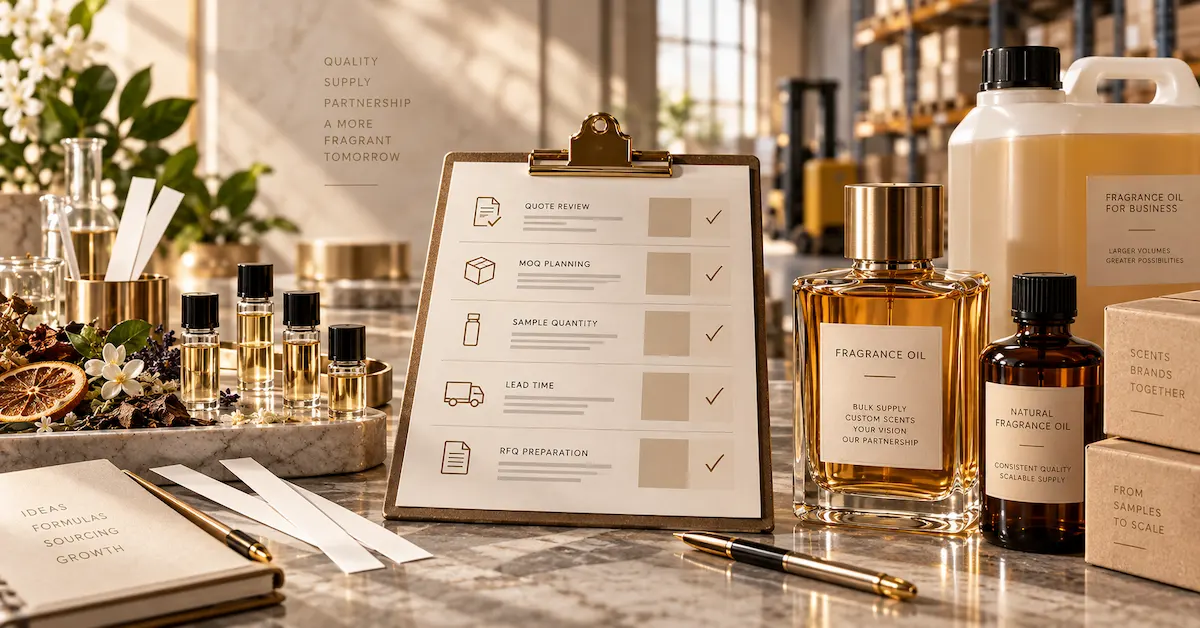
Think in Four Quantity Stages: Sample, Pilot, Initial Order and Scale
A more useful way to understand fragrance oil MOQ is to divide the purchasing process into stages.
Stage 1: Evaluation Sample
Goal:
Determine whether the fragrance direction is worth developing further.
Typical activities can include:
-
Olfactive review
-
Benchmark comparison
-
Base compatibility check
-
Preliminary application test
-
Internal buyer approval
At this stage, commercial bulk pricing may not yet be the main decision.
Stage 2: Pilot or Pre-Production Quantity
Goal:
Confirm that the approved fragrance performs under more realistic product-development conditions.
This stage may be relevant when the buyer needs:
-
Pilot production
-
Extended stability testing
-
Filling tests
-
Packaging compatibility
-
Consumer evaluation
-
Distributor samples
-
Regulatory preparation
-
Marketing samples
Not every project requires a distinct pilot order, but buyers should ask whether the supplier distinguishes between laboratory evaluation and commercial production.
Stage 3: Initial Commercial Order
Goal:
Launch the product without committing prematurely to long-term scale.
The first commercial order often needs to balance:
-
Supplier production efficiency
-
Buyer inventory risk
-
Forecast confidence
-
Launch volume
-
Cash flow
-
Reorder expectations
This is where MOQ becomes a strategic purchasing issue rather than a simple number.
Stage 4: Repeat Bulk Purchasing
Goal:
Create a predictable supply model.
A buyer that has validated demand can then discuss:
-
Larger batch sizes
-
Scheduled purchasing
-
Forecast agreements
-
Reorder planning
-
Longer-term pricing structures
-
Stock planning
-
Packaging efficiency
-
Raw-material planning
When comparing a bulk fragrance oil supplier, buyers should look beyond the first MOQ and ask whether the supplier can support this entire scaling path.
Why Fragrance Oil MOQ Varies Between Suppliers
Different fragrance oil suppliers may quote different minimum quantities even for apparently similar products.
This is not automatically evidence that one supplier is more flexible or more competitive.
Several commercial and technical factors may be involved.
1. Existing Formula vs New Formula
An existing fragrance direction generally requires less development setup than creating a new formula.
A new formula may involve:
-
Perfumery time
-
Raw-material selection
-
Trial formulas
-
Modification rounds
-
Application testing
-
Formula finalization
That additional work changes the commercial structure.
2. Formula Complexity
A simple fragrance direction and a complex fine-fragrance construction may not have the same production economics.
Complexity can be influenced by:
-
Number of materials
-
Availability of specific materials
-
Cost of specialty ingredients
-
Formula precision
-
Stability requirements
-
Performance targets
Buyers should therefore avoid comparing quotations based only on kilograms.
3. Raw-Material Procurement
Some formulas may rely on materials already used frequently by the supplier.
Others may require materials that are:
-
Less frequently stocked
-
Expensive
-
Market-sensitive
-
Imported
-
Subject to supplier minimums
-
Purchased specifically for the project
A low finished-product MOQ can become commercially difficult if key raw materials themselves require significant procurement commitments.
4. Application Requirements
A fragrance designed for a straightforward oil-based application may not require the same work as one intended for a difficult surfactant, alkaline, wax, alcohol, aerosol, high-temperature, or diffusion system.
Application-specific development can affect:
-
Formula design
-
Stability work
-
Testing
-
Sample iterations
-
Raw-material selection
Pureln organizes fragrance development around multiple end-use categories, from personal care and laundry to home fragrance, automotive and fine fragrance. Buyers can review these fragrance application categories when preparing application-specific inquiries.
5. Packaging Requirements
There is an important distinction between:
MOQ for bulk fragrance oil
and:
MOQ for a finished branded product.
Private-label perfume, room spray, reed diffuser or car fragrance may involve separate minimums for:
-
Bottles
-
Caps
-
Pumps
-
Boxes
-
Labels
-
Printed cartons
-
Decorative components
-
Custom molds
The fragrance oil itself may not be the component driving the final project minimum.
This is why RFQs should separate:
fragrance MOQ
from:
finished-product MOQ.
6. Documentation Requirements
Depending on the application and destination market, buyers may need technical or compliance documentation.
Document preparation should be discussed early rather than after bulk production.
For projects that require available fragrance documentation, buyers can use the SDS and regulatory document request as part of the technical follow-up process.
7. Confidentiality and Exclusivity
An existing fragrance direction used by multiple buyers is commercially different from an exclusive custom fragrance.
If the project involves:
-
Confidential benchmark samples
-
Proprietary formulas
-
Exclusivity
-
Market restrictions
-
NDA requirements
-
Protected brand concepts
the supplier may need to treat the commercial relationship differently.
The buyer should confirm these terms before assuming that the lowest possible custom fragrance oil MOQ includes exclusivity.
Stock vs Custom Fragrance: Which Purchasing Route Is Better?
Neither route is universally better.
The correct decision depends on the buyer's commercial objective.
| Purchasing Factor | Existing / Stock Direction | Custom Fragrance Direction |
|---|---|---|
| Speed to first evaluation | Usually faster | Usually requires more development |
| Initial development complexity | Lower | Higher |
| Brand differentiation | Moderate | Potentially higher |
| Formula adjustments | Limited to flexible modification scope | Built around project brief |
| Benchmark matching | May not be necessary | Often relevant |
| Application optimization | Still required | Can be integrated into development |
| Target-cost engineering | More limited | Can be considered in brief |
| Exclusivity | Usually not assumed | Must be discussed explicitly |
| Sample rounds | Often fewer | May require several iterations |
| Commercial MOQ logic | Often simpler | More project-dependent |
| Best for | Faster sourcing, testing, distributors | Brands, OEM projects, differentiated products |
A buyer should not automatically choose stock fragrance because the entry quantity appears easier.
Likewise, a buyer should not request full customization if the product does not need it.
The most efficient purchasing route is the one that matches the business model.
Fragrance Oil Lead Time: MOQ Is Only Half the Purchasing Question
Buyers frequently negotiate MOQ while overlooking fragrance oil lead time.
That can create problems even when the quantity is acceptable.
Lead time should be separated into several stages.
Development Lead Time
For a custom project, development may involve:
-
Receiving the fragrance brief
-
Reviewing the application
-
Selecting or creating fragrance directions
-
Preparing samples
-
Buyer evaluation
-
Modification
-
Re-evaluation
-
Final fragrance approval
The number of revision cycles can have a major effect on the overall timeline.
Application Validation Time
After the buyer likes the scent, the project may still need technical evaluation.
Depending on the application, validation could include:
-
Base compatibility
-
Aging
-
Stability
-
Color
-
Clarity
-
Viscosity
-
Diffusion
-
Evaporation
-
Packaging contact
-
Heat exposure
-
Scent retention
This time should not be confused with manufacturing lead time.
Commercial Production Lead Time
Only after the appropriate approvals can the project move to production scheduling.
Production timing can depend on:
-
Order quantity
-
Formula
-
Raw-material availability
-
Production schedule
-
Packaging scope
-
Documentation
-
Destination requirements
Shipping Time
Shipping is another separate component.
B2B buyers should therefore ask:
Is the quoted lead time sample preparation time, production time, or total time until shipment?
Without that distinction, “lead time” can be misleading.
Buyers planning a custom project can review the custom fragrance development process before setting an internal launch schedule.
What Information Does a Fragrance Oil Supplier Need to Quote Accurately?
One of the easiest ways to receive an inaccurate quotation is to send an incomplete inquiry.
A message such as:
“Please send price for fragrance oil.”
does not give a supplier enough information to understand the project.
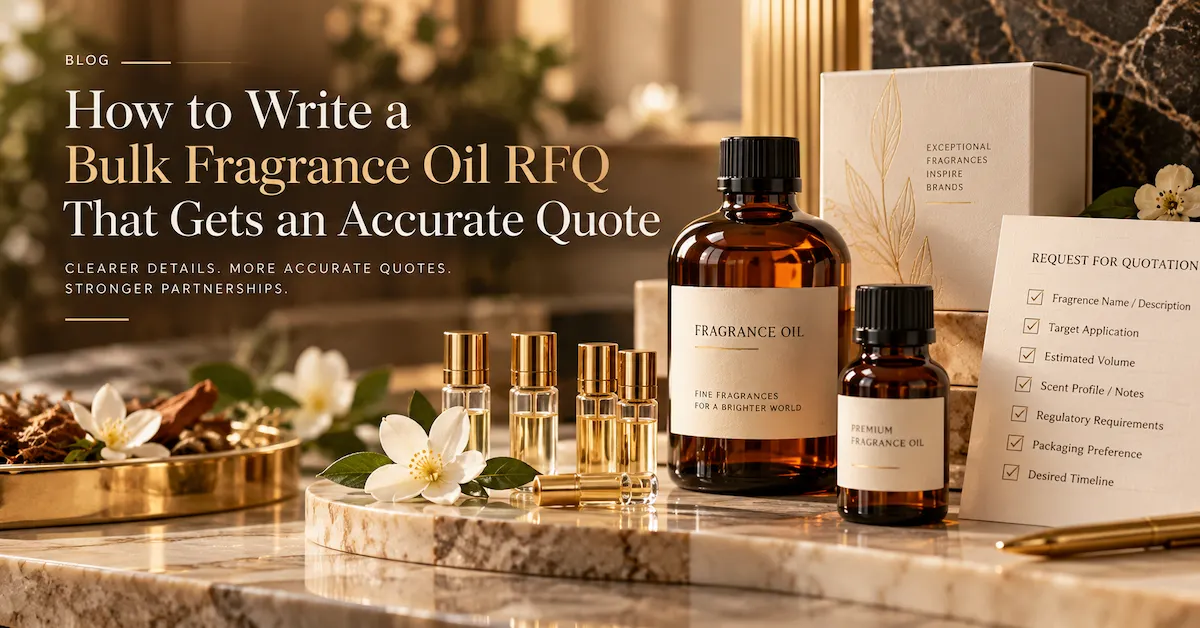
A professional RFQ should provide the following.
1. Application
State exactly where the fragrance will be used.
Examples:
-
EDP
-
Perfume oil
-
Shampoo
-
Body wash
-
Soap
-
Laundry detergent
-
Fabric softener
-
Floor cleaner
-
Reed diffuser
-
Candle
-
Room spray
-
Car diffuser
-
Hotel scenting system
-
Pet shampoo
Application changes the technical requirements.
2. Product Base
Where relevant, explain the base system.
Examples may include:
-
Alcohol-based
-
Oil-based
-
Water-based
-
Surfactant-based
-
Wax-based
-
Detergent base
-
Cleaner base
-
Diffuser carrier
The more technical the project, the more important this information becomes.
3. Fragrance Direction
Describe the desired olfactive profile.
Useful information includes:
-
Fresh
-
Floral
-
Fruity
-
Woody
-
Amber
-
Musk
-
Oud
-
Gourmand
-
Citrus
-
Clean
-
Herbal
Better still, provide:
-
Benchmark product
-
Reference sample
-
Target brand positioning
-
Notes to increase
-
Notes to reduce
-
Desired emotional impression
4. Stock vs Custom Requirement
State whether you are open to:
-
Existing fragrance options
-
Modification of an existing direction
-
Reference matching
-
Fully custom creation
This can significantly affect the commercial discussion.
5. Target Market
A fragrance for the Middle East may be positioned differently from one intended for Europe, North America, Japan or Southeast Asia.
Regional preference can affect:
-
Intensity
-
Scent family
-
Sweetness
-
Freshness
-
Diffusion
-
Product positioning
6. Target Price or Cost Range
Providing a realistic target allows the fragrance house to develop in the correct commercial direction.
Without a price framework, a supplier may create a scent that performs well but does not fit the buyer's finished-product economics.
7. Sample Requirement
Explain what the sample will be used for.
For example:
-
Olfactive approval
-
Laboratory formulation
-
Stability test
-
Pilot run
-
Customer presentation
-
Distributor review
The appropriate sample quantity depends on the validation process.
8. Estimated Bulk Quantity
Do not hide expected volume because you are worried about negotiation.
A reliable supplier needs a realistic estimate to discuss the appropriate production route.
Useful information may include:
-
Initial order estimate
-
Annual forecast
-
Expected reorder frequency
-
Number of fragrance variants
Forecast information does not need to be a binding purchase commitment. It is a planning input.
9. Packaging Scope
Clarify whether you need:
-
Bulk fragrance oil only
-
Customer-supplied packaging
-
Supplier packaging
-
Private label
-
Finished product
-
Custom bottle
-
Custom box
-
Custom mold
Otherwise, a supplier may quote the wrong scope.
10. Required Documents
Identify documentation needs before ordering.
Examples may include:
-
SDS
-
COA
-
IFRA-related documentation
-
Allergen information
-
Product specification
Documentation should be confirmed for the particular formula, application and market rather than assumed.
11. Timeline
Give the supplier an actual launch schedule.
Include:
-
Desired sample date
-
Evaluation period
-
Target approval date
-
Target production date
-
Desired shipment date
This allows the supplier to flag unrealistic timing before the project reaches a critical stage.
A Better Fragrance Oil RFQ Template
Instead of sending:
We need fragrance oil. What is your MOQ and price?
send something closer to:
Application: Liquid laundry detergent
Target Market: UAE and Saudi Arabia
Fragrance Direction: Clean floral musk with strong freshness
Reference: Benchmark sample available
Development Type: Custom or modified direction
Performance Priority: Long-lasting perception on fabric
Sample Purpose: Formula and stability evaluation
Initial Commercial Volume: To be confirmed after sample approval
Annual Forecast: Available for supplier discussion
Packaging: Bulk fragrance oil
Documents Required: Please confirm available technical documents
Target Price: Provide options if possible
Launch Timing: Commercial launch planned after validation
This type of inquiry gives a fragrance oil supplier enough information to provide a meaningful response.
How to Compare Quotes From Bulk Fragrance Oil Suppliers
The lowest MOQ is not necessarily the best quotation.
A useful comparison should examine at least seven dimensions.
| Comparison Item | What the Buyer Should Confirm |
|---|---|
| MOQ | What exactly does the minimum quantity apply to? |
| Price | Is pricing for the same formula quality and scope? |
| Sample | What is included in evaluation and modification? |
| Customization | Existing formula, modification or full custom development? |
| Lead Time | Sample, development, production and shipping separated? |
| Documentation | Which documents are available for the actual formula? |
| Scale | Can the supplier support repeat bulk production? |
Compare Like With Like
Supplier A may offer a lower minimum quantity using an existing fragrance.
Supplier B may quote a higher minimum for a custom-developed formula.
Those quotations are not equivalent.
Before deciding, confirm:
-
Is the fragrance identical in scope?
-
Are application tests included?
-
Are modification rounds included?
-
Is the same packaging included?
-
Are the same documents included?
-
Is the formula exclusive?
-
Is the quote for bulk oil or finished goods?
-
Is shipping included?
-
Is sample development included?
A commercial comparison without these questions can lead to a false conclusion about supplier competitiveness.
When a Lower MOQ Can Actually Cost More
Buyers often assume lower MOQ means lower risk.
Sometimes it does.
Sometimes it shifts cost elsewhere.
A very small order can have disadvantages such as:
-
Higher cost per unit
-
Repeated shipping charges
-
Repeated import costs
-
More frequent purchasing administration
-
Greater risk of stockouts
-
Inconsistent reorder scheduling
-
Less efficient packaging procurement
-
Difficulty maintaining production continuity
The correct objective is not:
Find the lowest possible MOQ.
It is:
Find the lowest commercially sensible quantity that supports product validation, launch risk and future supply.
A startup fragrance brand may need a different answer from a multinational household-care manufacturer.
MOQ should reflect the buyer's stage.
When a Higher MOQ May Be Reasonable
A higher MOQ may be commercially justified when the project includes:
-
Dedicated formula development
-
Specialized raw materials
-
Custom packaging
-
Private mold development
-
Exclusive formulation
-
Large production setup
-
Market-specific finished products
-
Stable long-term forecasts
The buyer should not automatically accept a higher quantity, but should ask:
What specific production or development requirement is driving this MOQ?
A professional supplier should be able to explain the commercial logic.
How to Negotiate Fragrance Oil MOQ Without Damaging the Project
Good MOQ negotiation is not simply asking the supplier to “reduce the MOQ.”
A better strategy is to reduce the complexity that drives the minimum.
Option 1: Start With an Existing Fragrance Direction
If exclusivity is not essential, evaluating an existing direction may simplify the first project.
Option 2: Reduce the Number of Fragrance Variants
Ordering five scents at a small quantity each can be less efficient than starting with one or two priority directions.
Option 3: Separate Bulk Oil From Finished Packaging
If custom packaging is driving the project minimum, buying bulk fragrance oil separately may create more flexibility.
Option 4: Use Standard Packaging for the First Launch
For finished private-label projects, avoiding private molds or specialized components can reduce complexity.
Option 5: Provide a Realistic Annual Forecast
A supplier may evaluate a first order differently when there is credible repeat demand.
Option 6: Approve Technical Requirements Early
Late changes to formula, fragrance direction, packaging or documents can increase cost and extend timelines.
Option 7: Ask for a Scaling Plan
Instead of negotiating only the first MOQ, ask:
-
What is the evaluation route?
-
What is the initial commercial route?
-
What changes at larger volumes?
-
What should we forecast for repeat orders?
This creates a more useful supplier conversation.
MOQ Considerations by Fragrance Application
Fragrance oil is not a single standardized commodity.
The application changes what needs to be validated before volume purchasing.
Fine Fragrance
For perfume oil concentrate, EDP, EDT and related formats, buyers may need to evaluate:
-
Scent structure
-
Dilution
-
Alcohol or carrier compatibility
-
Clarity
-
Color
-
Maturation
-
Projection
-
Dry-down
Brands developing concentrated perfume systems can review perfume oil concentrate development before preparing a custom inquiry.
Home Fragrance
For reed diffuser, room spray and similar applications, purchasing decisions may need to consider:
-
Carrier compatibility
-
Diffusion
-
Evaporation
-
Residue
-
Color
-
Packaging interaction
Personal Care
Shampoo, body wash, soap and lotions can introduce questions around:
-
Base compatibility
-
Scent bloom
-
Color
-
Viscosity
-
Stability
-
Rinse-off behavior
Laundry
Laundry projects may prioritize:
-
Base stability
-
Wet fragrance perception
-
Dry fabric perception
-
Long-lasting character
-
Compatibility with detergent or softener systems
Automotive
Car fragrance may face:
-
Elevated temperature
-
Airflow
-
Small enclosed spaces
-
Packaging contact
-
Material compatibility
-
Controlled evaporation
-
Residue concerns
In each case, MOQ should be considered only after the project scope is clear.
What a Fragrance Oil Sample Supplier Should Help You Evaluate
A fragrance oil sample supplier should do more than send a bottle and ask whether the buyer likes the smell.
For B2B development, sample evaluation should help the buyer move toward a commercial decision.
Useful questions include:
-
What application is this sample intended for?
-
Is it being evaluated neat or in the finished base?
-
What dosage or concentration range will be tested?
-
What benchmark is being used?
-
What performance requirement matters most?
-
Will the buyer conduct stability testing?
-
What would trigger a formula modification?
-
What documentation will be needed after approval?
-
What volume is expected after successful validation?
The objective is not merely sample delivery.
The objective is to reduce uncertainty before bulk ordering.
What to Confirm Before Paying for a Bulk Order
Before placing a commercial order, B2B buyers should confirm the following points in writing.
Commercial Scope
-
Product or formula identification
-
Stock or custom status
-
Order quantity
-
Price basis
-
Packaging
-
Payment terms
-
Shipping terms
Technical Scope
-
Intended application
-
Approved sample or reference
-
Formula version
-
Relevant product specification
-
Required evaluation status
Documentation
-
Required documents
-
Product identification consistency
-
Destination-market requirements where applicable
Timeline
-
Production timing
-
Expected readiness
-
Shipping arrangement
-
Critical launch date
Future Reorders
-
Formula continuity
-
Reorder process
-
Forecast expectations
-
Batch identification
-
Any conditions affecting future price or MOQ
The more clearly these items are confirmed, the lower the risk of disputes after production begins.
How to Evaluate a Fragrance Oil Supplier Beyond MOQ
MOQ is a commercial filter, not a complete supplier qualification system.
A serious buyer should also evaluate whether the supplier understands:
Application
Can the supplier explain why fragrance performance changes in different product bases?
Sampling
Is there a clear sample and feedback process?
Custom Development
Can the supplier modify or develop fragrance directions around a defined brief?
Quality Control
Is there a structured way to manage approved formulas and finished production?
Documentation
Can required documentation be discussed at formula and application level?
Production Scale
Can the supplier move from development to repeat bulk orders?
Communication
Does the sales or technical team ask detailed questions before quoting?
Interestingly, a supplier that asks more questions at the beginning may be more useful than one that immediately sends a price.
If you are comparing potential partners, the fragrance manufacturer selection guide provides a broader framework for evaluating R&D, quality, customization and production capability.
Red Flags When Comparing Fragrance Oil MOQ Offers
B2B buyers should investigate further when a quotation has any of the following problems.
One MOQ for Every Fragrance and Application
Fragrance applications vary considerably.
A universal answer without asking about the project may indicate that the quotation does not reflect actual requirements.
No Distinction Between Sample and Commercial MOQ
Sample quantities and production quantities serve different purposes.
They should be discussed separately.
Custom Fragrance Quoted Without a Brief
If the supplier has not asked about:
-
Application
-
Market
-
Fragrance direction
-
Performance
-
Quantity
it is difficult to know what “custom” actually includes.
Lead Time With No Definition
Ask whether the number refers to:
-
Sample preparation
-
Development
-
Production
-
Packaging
-
Total project duration
Documents Promised Without Formula Confirmation
Documentation availability can depend on the actual formulation and application.
Avoid assuming every certificate or document automatically applies to every fragrance.
Low MOQ but No Scaling Plan
A startup-friendly initial order is useful only if the supplier can support the next stage.
Ask what happens when demand grows.
Ten Questions to Ask Before Confirming Fragrance Oil MOQ
1. Is this MOQ for a stock fragrance or a custom fragrance?
Always establish the development scope first.
2. Does the MOQ apply to fragrance oil or finished private-label products?
Packaging can create a separate minimum.
3. What sample quantity is available before commercial production?
The answer should match your testing plan.
4. Is there a pilot quantity between sample and bulk production?
This can matter for technical applications.
5. What information is required before receiving a firm quotation?
Expect questions about application, scent direction, quantity and commercial requirements.
6. What factors could change the MOQ later?
Ask about formula changes, raw materials, packaging and customization.
7. What does the quoted fragrance oil lead time include?
Separate development, approval and production.
8. Are technical documents available for the final approved formula?
Confirm this before ordering.
9. Can the supplier support larger repeat orders?
MOQ should be evaluated together with scalability.
10. What happens if the first sample requires modification?
Understand the revision process before starting development.

FAQ: Fragrance Oil MOQ for B2B Buyers
What is a typical fragrance oil MOQ?
There is no single MOQ that should be assumed for every fragrance project. Minimum quantities can vary according to formula status, customization, raw-material requirements, application, production method, packaging and commercial volume. Buyers should request a project-specific MOQ instead of relying on a generic industry number.
Is stock fragrance oil MOQ usually different from custom fragrance oil MOQ?
It often can be. Existing fragrance directions may require less dedicated development than a new custom formula. A custom project may involve perfumery work, modification rounds, application evaluation or dedicated materials, which can change the commercial structure.
Can I request samples before meeting the bulk MOQ?
Sample evaluation and bulk production are normally separate stages in B2B development. The appropriate sample quantity depends on the testing purpose. Buyers should explain whether samples will be used for scent evaluation, formulation testing, stability work, pilot production or customer approval.
What is the difference between sample quantity and MOQ?
A sample quantity is intended for evaluation. MOQ is the minimum commercial quantity under a defined production arrangement. Buyers should not assume that a supplier's sample amount represents the minimum quantity for bulk production.
Why does custom fragrance oil have a different MOQ?
Custom projects may involve formula creation, benchmark matching, raw-material selection, modification rounds, application testing and dedicated production preparation. The exact impact depends on the project, so buyers should ask the supplier which parts of the custom scope affect the minimum.
Does fragrance oil lead time increase for custom projects?
It can. A custom project may require brief interpretation, sample development, buyer feedback, formula revisions and application validation before commercial production. Buyers should distinguish development lead time from manufacturing lead time.
What should I send to a bulk fragrance oil supplier for a quotation?
Provide the application, product base, fragrance direction, target market, stock or custom requirement, sample purpose, expected bulk quantity, annual forecast if available, packaging scope, document requirements, target price range and required timeline.
Can MOQ be negotiated?
Sometimes the project structure can be adjusted. Buyers may consider an existing fragrance direction, fewer variants, standard packaging, bulk oil instead of finished goods, or a phased purchasing plan. Negotiation should focus on reducing production complexity rather than only demanding a lower number.
Is the lowest fragrance oil MOQ always the best option?
No. A low MOQ can reduce initial inventory exposure, but buyers should also consider unit economics, freight, import costs, supply continuity, documentation, technical support, sample quality and future scalability.
How should I ask Pureln about fragrance oil MOQ?
Prepare a structured brief covering your application, fragrance direction, target market, testing requirements, estimated order volume and timeline. You can request fragrance samples for evaluation or contact Pureln about a B2B fragrance project to discuss the appropriate purchasing route.
Conclusion
Fragrance oil MOQ should never be evaluated as an isolated number. For B2B buyers, the meaningful comparison is the complete purchasing route: stock versus custom fragrance, sample quantity, application validation, initial bulk quantity, fragrance oil lead time, documentation, packaging scope and future reorder requirements.
Before requesting a quotation, define the application, product base, target market, scent direction, sample purpose, expected volume and timeline. This allows a fragrance oil supplier to quote against a real project instead of a vague request and helps buyers compare suppliers on equal terms.
If you are preparing a new fragrance project, use Pureln's fragrance sample request form for evaluation or submit your B2B fragrance brief to discuss the next step.