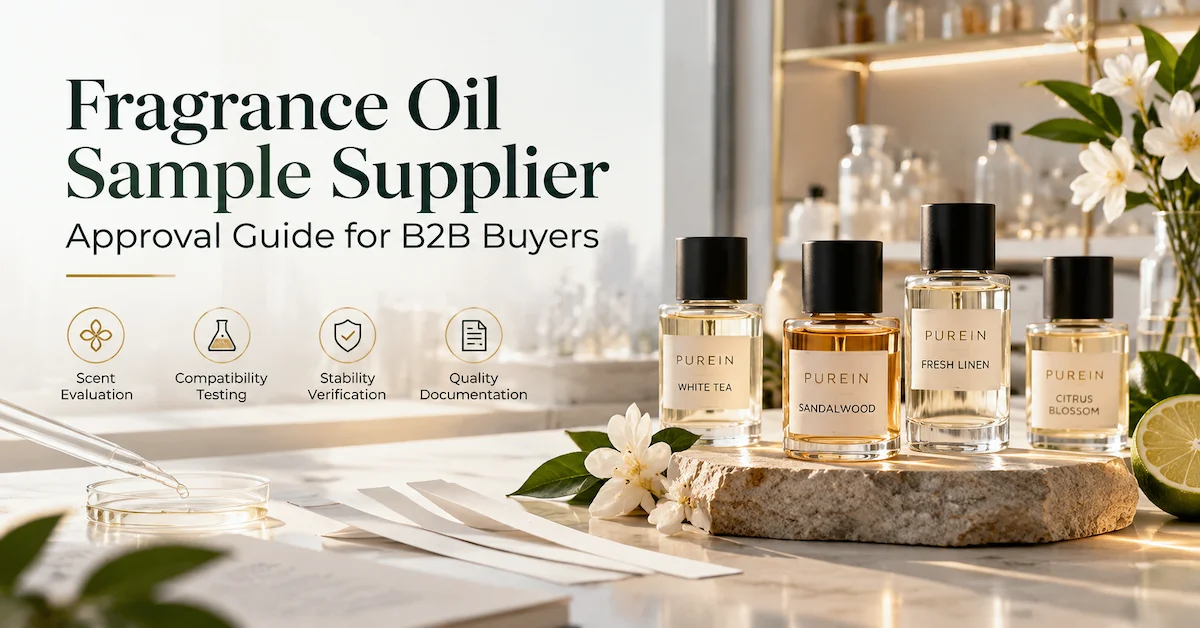
Short answer: Approve a fragrance oil sample for bulk production only after it passes four checks in the intended finished product: sensory fit, base compatibility, storage and packaging stability, and document and batch traceability. A sample that smells right on a blotter can still haze a liquid, discolor a soap, attack a closure, lose its character in storage, or fail a customer quality review. The right fragrance oil sample supplier therefore helps you evaluate the oil in context and records what was approved.
For procurement teams, this is a commercial approval problem as much as a formulation problem. You are deciding whether a supplier can repeat the approved scent at the agreed cost, pack it safely, deliver it on the project timeline, and support your target market with the right documents. For R&D and quality teams, the question is narrower but more demanding: does this exact sample, at the intended dosage and in the intended material system, meet the acceptance criteria that will be used after launch?
This article focuses on the purchasing workflow, not a complete technical guide for shampoo, detergent, perfume, reed diffuser, or any other single application. Use the steps below to compare a custom fragrance manufacturer, qualify a bulk fragrance oil supplier, and create an approval record that production can understand months later.
What a buyer is actually approving
“Sample approved” is often written as if it describes only an odor. In a B2B project it should describe a controlled package of decisions. The approved item is the fragrance formula or reference code, the use level or range, the product base, the packaging contact materials, the target market, the required documents, and the supplier's change-control expectations. If one of those variables is missing, the approval can be difficult to reproduce.
A useful approval statement is specific enough that a second person can repeat it. For example: “Sample FO-24-017, evaluated at the agreed dosage in the customer's final liquid base, met the sensory, appearance, seven-day screening, packaging-contact, and document checks for the North American launch. Bulk production requires confirmation against the retained golden sample.” That is more useful than “smells good” because it defines the boundary of the decision.
The four questions behind every approval
- Does it fit the brief? The scent direction, strength, cost position, target market, and format must match the commercial brief.
- Does it work in the product? The oil must be evaluated in the real base, not only in a bottle or on a strip.
- Can it survive the supply chain? Storage, transport, closure, label, and outer packaging must be considered before release.
- Can the supplier repeat it? The supplier must show a traceable sample and a practical plan for batch consistency, documents, and change notification.
Evidence a fragrance oil sample supplier should provide
Supplier evidence is not a substitute for your own product testing, but it tells you whether the supplier understands a buyer's approval process. Ask for evidence that is tied to the sample code and project, rather than a generic capability statement.
| Evidence to request | What it answers | Approval note |
|---|---|---|
| Sample code, revision, date and retained reference | Which material was tested? | Write the code on the approval record and purchase order. |
| Recommended use level or range | At what concentration is performance being claimed? | Do not compare two suppliers at different dosage levels. |
| Material and process information relevant to the base | What may affect solubility, color, viscosity or scent release? | Confirm the formula and process remain within the tested window. |
| SDS, IFRA-related document, COA, allergen or specification support as applicable | Can the quality and regulatory teams review the project? | Documents must match the formula, market and application. |
| MOQ, lead time, packing method and change-control process | Can the approved material be purchased and repeated? | Treat these as project-specific commercial terms, not assumptions. |
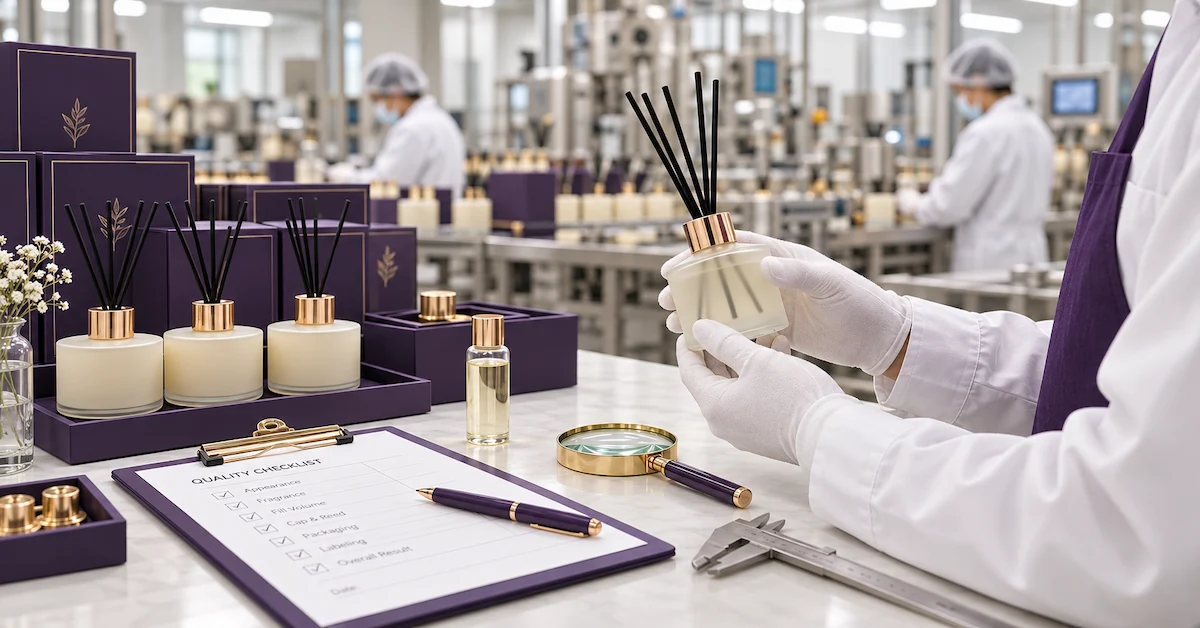
Pureln's public factory profile identifies Guangzhou as its manufacturing location and describes a 14,860 m2 manufacturing base, four production lines, 15 R&D engineers, and eight QC inspectors. The same page describes oil blending, sampling, OEM/ODM support, packaging customization, and export delivery. These are useful supplier-screening signals, but they are public company statements, not a substitute for a project audit or a batch-specific certificate.
Step 1: Freeze the approval brief before testing
Most sample disputes start before the sample arrives. One team evaluates a neat oil, another evaluates a finished product, and purchasing compares a third price at a different use level. Prevent that by freezing a one-page approval brief before asking suppliers for final samples.
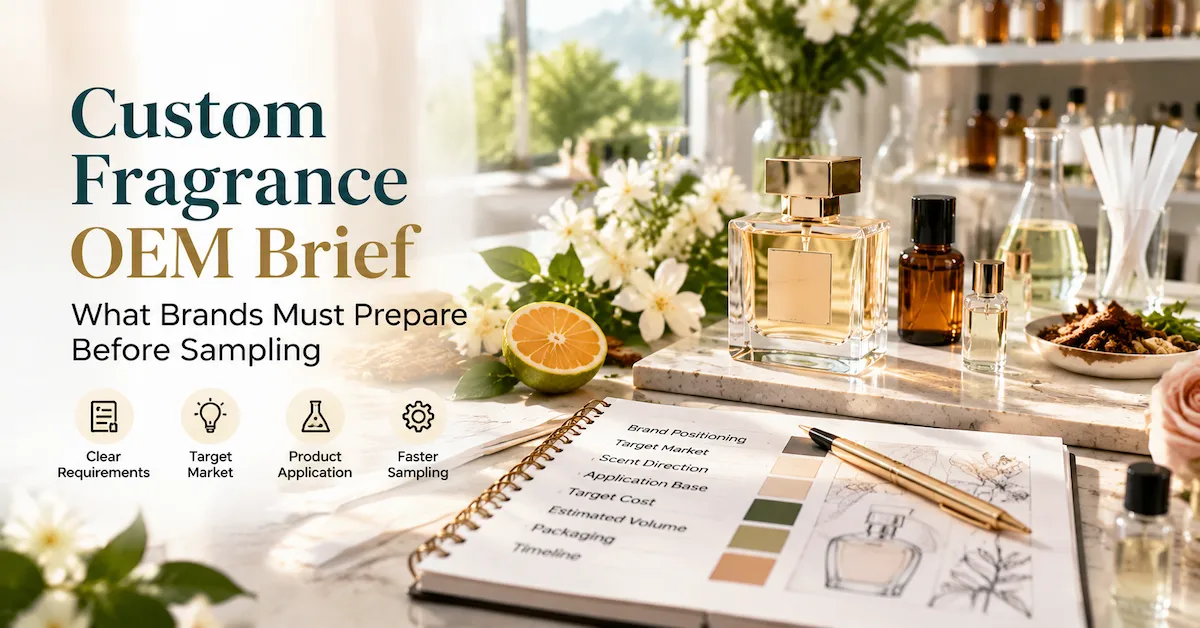
Include these commercial fields
- Product and application: for example, fine fragrance, personal care, home care, laundry, reed diffuser, air care, automotive or another defined format.
- Base and process: water, alcohol, oil, surfactant, wax, solvent, carrier, pH range, heating step, mixing order and any filtration or filling conditions that can affect performance.
- Target market: country or region, channel, consumer positioning and any market-specific document or restricted-material requirements.
- Olfactory direction: reference scent, desired opening and dry-down, intensity, character to avoid, and whether the goal is a close match or an original direction.
- Commercial frame: target price, estimated annual volume, launch date, sample size, planned bulk pack and target shelf life.
- Acceptance authority: name the people who can approve scent, formulation, regulatory documents and commercial terms.
Pureln's sample request form is structured around application, solubility, target price and estimated annual volume. Its public contact brief also asks for formula or base system, target market, required sample size, project timeline and required documents. Those fields are a practical minimum for any fragrance oil sample supplier comparison because they connect scent selection to a real purchasing decision.
Step 2: Confirm the sample identity and materials
When a sample arrives, log the label, code, revision, quantity, date received, packaging, and visible condition before opening it. Photograph the container and retain enough material for a repeat check. If the supplier sends a revised formula under the same name, pause approval until the revision is explained.
Material information should be handled with the same discipline. A public sample-specific MSDS linked by Pureln identifies a fragrance essential oil and lists a carrier and aromatic materials including dipropylene glycol, phenylethyl alcohol, vanillin, bergamot oil, geranium oil, lemon oil, orange oil, jasmine oil, lavender oil and other components with concentration ranges. The published example gives dipropylene glycol at 10-50%, phenylethyl alcohol at 2-10%, vanillin at 1-2% and bergamot oil at 5-20%. That document is useful evidence that a supplier can provide composition and handling information for a particular sample. It is not permission to assume that every fragrance oil uses the same ingredients or ranges. Request the document for the actual formula under review.
Also ask what the container is made from and what the finished pack will use. The same oil can behave differently when it contacts glass, coated metal, HDPE, PET, a pump, a gasket, a reed, a label adhesive or a decorative coating. “The oil is stable” is incomplete unless the supplier and buyer agree on the contact materials and storage conditions.
Step 3: Test base compatibility, not just neat odor
A fragrance compatibility testing service should answer whether the oil remains usable and visually acceptable in the real product system. When comparing providers, ask whether the same team can test your base, your production process and your planned pack. Evaluate the oil at the intended use level and, where the process allows, at a low and high boundary around that level. Record the base lot, batch date, mixing order, temperature, mixing time and observation time. Otherwise a supplier cannot reproduce a failure or a pass.
Compatibility observations to record
- Clarity and phase behavior: clear, hazy, separated, precipitated or changed after dilution and after standing.
- Color: initial color, change after processing, and change after storage against a retained control.
- Viscosity and flow: any meaningful change that could affect dosing, pumping, filling or diffusion.
- Foam, sediment or residue: relevant where surfactants, powders, waxes, porous materials or atomization systems are involved.
- Odor in the base: opening, body, dry-down, off-notes and interaction with the base odor.
- Process tolerance: behavior after heating, cooling, shear, filtration, filling or other production steps.
Do not use a single universal pass/fail limit for every product. A slight color shift may be acceptable in an amber cleaner but unacceptable in a clear premium serum; a trace of residue may be irrelevant in a sealed bottle but critical in a cold-air diffuser. Define the limit with the product owner and record the reason.
| Test layer | Buyer question | Evidence to retain |
|---|---|---|
| Neat oil | Does the sample match the brief before dilution? | Reference strip or blotter notes, sample photo and code. |
| Finished base | Does it remain clear, stable and acceptable in the real product? | Formula version, dosage, process record and photos. |
| Packaging contact | Does it interact with the bottle, closure, liner or label? | Contact material list and stored pack observations. |
| Production simulation | Does it survive the actual mixing, filling and handling steps? | Pilot batch number, process conditions and deviations. |
Step 4: Run stability and retention checks
A fragrance stability testing service should be designed around the product's risk. When a fragrance stability testing service proposes a test, ask whether it covers the formula, the pack and the performance that your customer will actually experience. A buyer does not need the same study for a sealed alcohol perfume, a water-based cleaner, an open reed diffuser, a fabric-care product, and a car air freshener exposed to heat. The test plan should explain what condition is being used, what is measured, how long the sample is observed, and what counts as a failure.
Use three stability lenses
- Formula stability: inspect odor, color, clarity, separation, sediment, viscosity and other product-specific properties after the agreed storage conditions.
- Packaging stability: inspect leakage, swelling, stress cracking, discoloration, label lift, closure change and loss of fragrance from the pack.
- Performance stability: compare the scent journey at the start and end of the study, including opening, dry-down, diffusion, rinse-off or fabric retention where applicable.
Use a retained control and the same evaluator instructions each time. Blind evaluation is helpful when two suppliers or two revisions are being compared. Photographs can support appearance observations, but they do not replace a sensory record or an instrumental measurement where the product team has one.
Public Pureln evidence illustrates why scope matters. A linked MSDS for one fragrance essential oil states that the sample is stable under recommended storage conditions and should be kept away from high temperature and ignition sources. Separate sea and air transport reports, inspected on December 18, 2025 and issued on December 19, 2025, describe a tested light-yellow liquid sample with an aromatic odor and report that the tested sample was not restricted under the cited transport rules. Those documents support handling and logistics review for the tested sample; they do not prove finished-product shelf life, packaging compatibility or unrestricted transport for every formula. Ask for the right evidence for the specific shipment and market.
Retention is a separate decision
“Long-lasting” is not a universal property. Define the moment that matters to the customer: immediately after application, after drying, after a wash cycle, after a room has been scented for a target period, or after a diffuser has operated under a defined setting. Compare the approved sample with a control at the same dosage and under the same conditions. Record who evaluated it and whether the result is a commercial preference, a technical requirement or a regulatory constraint.
Step 5: Check packaging and material compatibility
Packaging is part of the formula system. Before bulk production, fill a representative pack with the sample or pilot blend and keep it in the planned orientation. Check the bottle, cap, pump, gasket, liner, reed, wick, label adhesive, ink and carton if they can contact or be affected by the oil. Ask the supplier to confirm the planned bulk container and transport pack rather than sending an unlabelled drum assumption.
For small brands, the packaging question is often where a pleasant sample becomes an expensive launch delay. A fragrance may soften a gasket, stain a label, cloud a clear bottle, or change how a pump primes. A supplier that asks for your material specification early is showing better application discipline than one that quotes only a scent name and a price.

Step 6: Review documents before commercial release
Document review should happen before the purchase order is released, not after the first bulk shipment arrives. The exact list depends on the application and market, but common requests include an SDS, IFRA-related use information, COA, allergen declaration, INCI or ingredient information where relevant, specification sheet, transport information and a change-control contact.
Use the Quality and Compliance Hub as the internal link for this stage, but keep the approval logic practical: each document must identify the material or formula it covers, the revision or date, and any limitation. A certificate that belongs to a different product or a different application is not evidence for your sample.
Do not confuse the main documents
| Document | Useful for | What it does not prove alone |
|---|---|---|
| SDS / MSDS | Hazard communication, handling, storage and transport context. | Finished-product performance or your formula's stability. |
| IFRA-related information | Use-level and fragrance safety review for the relevant application category. | Approval for every market, base or finished product without review. |
| COA | Lot-specific quality results and release checks when supplied. | Your sensory approval or packaging compatibility. |
| Specification sheet | Agreed physical and quality characteristics for purchasing and QC. | A guarantee that the same oil works in an untested base. |
| Transport report | Shipment planning for the tested material under the stated mode and rules. | A blanket classification for all formulas or destinations. |
Step 7: Set MOQ, lead time and packaging terms
Do not ask only “What is your MOQ?” Ask which MOQ applies to which route. A stock fragrance, a minor adaptation, a fully custom formula, and a private-label finished product can have different minimums. The same applies to lead time: sample preparation, formula adjustment, compliance review, raw material purchasing, production, packing and export documentation may each have a different clock.
Because public website pages do not state one universal MOQ or lead-time promise for every fragrance, treat both as quotation fields. Put the following in the RFQ and require a written answer:
- Sample quantity and number of revisions included.
- MOQ by formula, fragrance oil weight, finished unit or packaging component.
- Sample lead time and bulk lead time, with the start event clearly defined.
- Raw-material or packaging dependencies that can extend the schedule.
- Bulk container size, inner protection, seal, label, palletization and export carton.
- Whether the approved sample is retained as a golden sample and for how long.
- How price changes, formula changes, supplier changes and out-of-spec lots are communicated.
A good bulk fragrance oil supplier will not hide behind a single number. It will explain what the number covers and which project variables could change it. A custom fragrance manufacturer should be able to connect those commercial terms to formula development, testing, raw-material planning and release timing. That transparency helps purchasing compare offers on total landed risk rather than on sample price alone.
Step 8: Verify batch consistency before you approve bulk
Fragrance batch consistency testing should connect the approved sample to the first production lot and to future replenishment. Ask the supplier to show how its fragrance batch consistency testing record links the lot, the retained golden sample and the release decision. At minimum, define the sensory reference, sample conditioning, evaluator group, physical checks, document checks and escalation path. For high-volume or highly branded projects, consider a comparison of more than one production lot against the retained golden sample.
A practical release record
| Record field | Why it matters |
|---|---|
| Approved sample code and revision | Prevents an old or alternate formula from being purchased. |
| Base, dosage, process and pack | Defines the conditions under which the sample passed. |
| Pass/fail criteria and evaluator names | Makes a subjective decision auditable and repeatable. |
| Supplier lot, COA and retained sample location | Supports complaint investigation and replenishment comparison. |
| Change-control and corrective-action contact | Creates a clear route when a lot or formula changes. |
Do not promise that every batch will smell identical in an absolute sense. Natural materials, raw-material availability, aging, packaging and evaluation conditions can create variation. The purchasing requirement is a defined, agreed consistency window and a documented process for handling a result outside that window.
How to score suppliers without overvaluing a nice scent
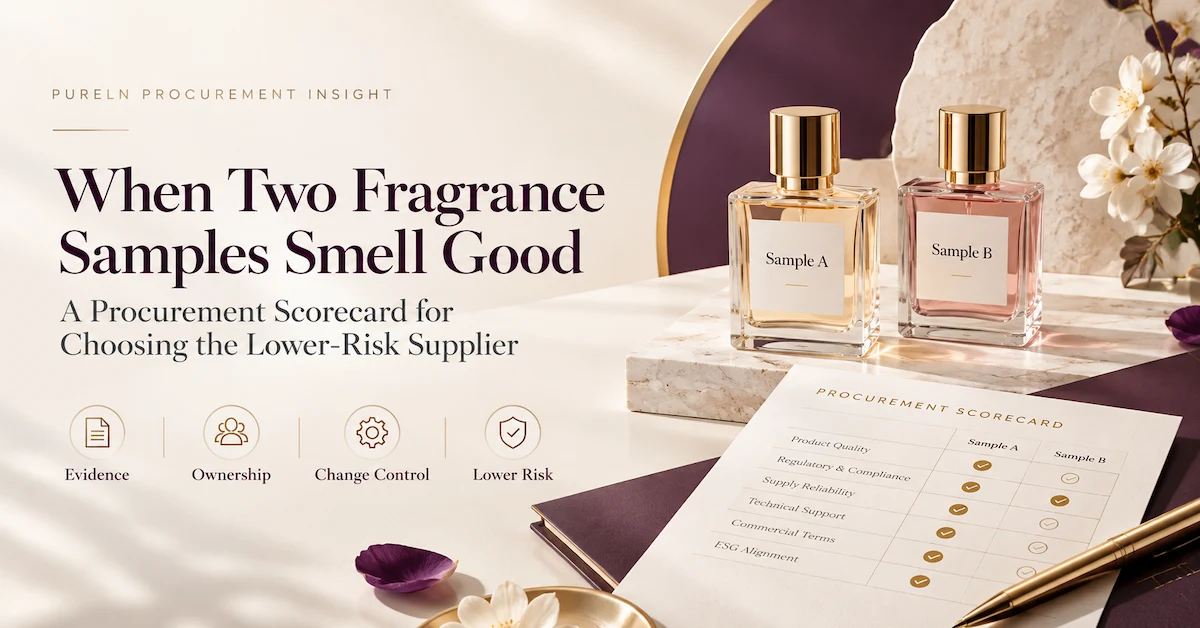
For a commercial investigation, score the supplier and the sample separately. A beautiful scent from a supplier that cannot answer packaging, document or batch questions is not a low-risk approval. Conversely, a technically strong supplier may need one more iteration to reach the exact olfactive direction. Keep those decisions visible.
| Decision area | Suggested question | Red flag |
|---|---|---|
| Technical fit | Can you test our actual base and pack? | Only neat-oil smelling or generic application claims. |
| Evidence | Can each document be tied to the sample code and market? | A certificate with no formula, revision or scope. |
| Commercial fit | What changes MOQ, price or lead time? | A low headline price with no pack or logistics assumptions. |
| Consistency | How will the first lot be compared with the approved sample? | No retained sample, lot reference or escalation route. |
| Communication | Who owns technical questions after the order? | Sales cannot identify an R&D or QC owner. |
Pureln describes its development model as application-led: its public “How We Do It” page connects perfumery, application testing and B2B documentation, with working labels such as long-lasting, high diffusion, low residue, malodor masking, soap stable, shampoo stable and cold-air diffuser suitable. Use those labels as prompts for a technical conversation, not as automatic claims for your finished product. Ask which label applies to your exact base, dosage and test method.
What to send in an RFQ for faster, more accurate samples
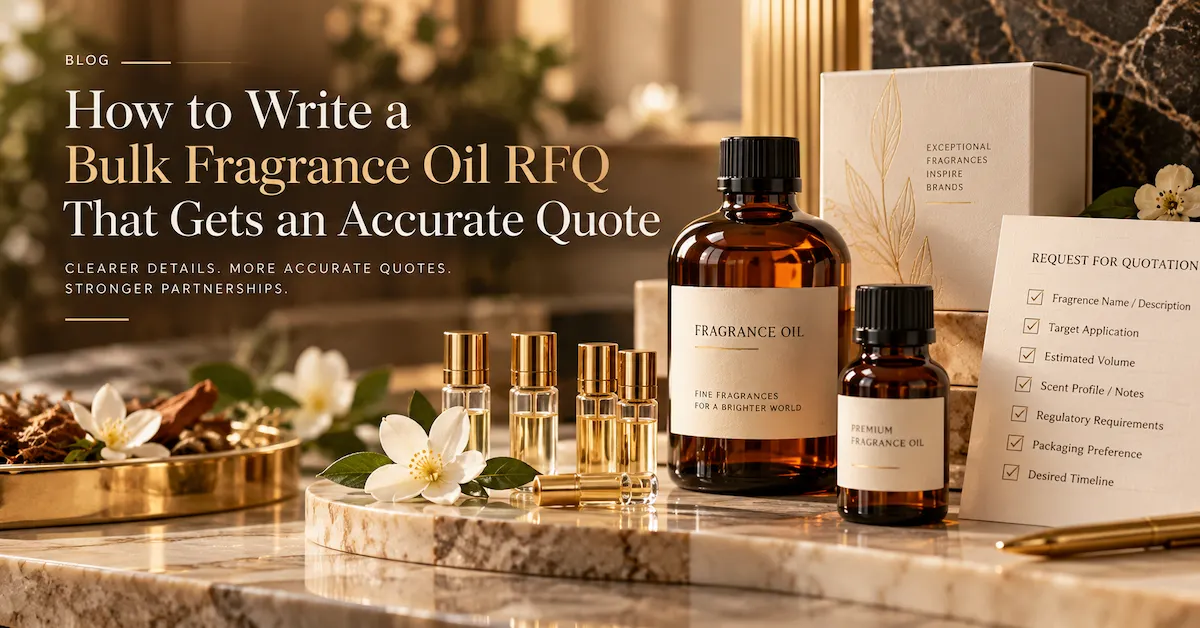
A supplier cannot quote or test responsibly when the RFQ says only “send a strong clean fragrance.” Include the inputs below. They reduce back-and-forth and make two suppliers easier to compare.
- Product type, application and finished-product format.
- Base formula or a representative base sample, including pH, alcohol, surfactant, oil, wax or carrier information where relevant.
- Target market and intended use level or an acceptable starting range.
- Reference scent, scent family, desired intensity, notes to avoid and whether matching is required.
- Target price, estimated annual volume, desired sample size and launch date.
- Packaging materials, closure, filling process and expected storage or transport conditions.
- Required documents and any customer or market-specific restrictions.
- Decision makers and the date by which sensory, technical and commercial approval must be complete.
Pureln's public sample and contact workflows ask for many of these fields, including application, solubility, target price, annual volume, base system, target market, sample size, timeline and documents. That structure is useful even when you are evaluating another supplier because it converts a vague scent request into a traceable purchasing brief.
FAQ: fragrance oil sample approval
Is smelling a fragrance oil sample enough?
No. Neat sensory evaluation is a useful first filter, but approval should include the finished base, intended dosage, storage, packaging contact and required documents. The more the product relies on clarity, retention, diffusion or a sensitive material, the less useful a blotter-only decision becomes.
What should I ask a fragrance oil sample supplier before bulk production?
Ask for the sample code and revision, recommended use level, compatibility test plan, stability evidence, packaging assumptions, SDS and application-relevant regulatory documents, MOQ, lead time, bulk packing, retained sample and change-control process. Ask which answers are fixed and which depend on your formula, market or volume.
Can a supplier promise one MOQ for every fragrance?
Usually not responsibly. MOQ can vary between stock, adapted and custom formulas, and it can also change with packaging or raw-material requirements. Request the MOQ for your specific route and unit of measure, then record it in the quotation and purchase order.
How long should fragrance stability testing take?
There is no single correct duration. The study should match the product's shelf-life risk, launch schedule, packaging, storage conditions and market requirements. Use an agreed screening stage for early decisions and a longer or more specific study when the product or customer requires it. Never turn a short screening result into a blanket shelf-life claim.
Which documents are normally reviewed before approval?
Depending on the application and market, buyers commonly review an SDS or MSDS, IFRA-related information, COA, allergen declaration, ingredient or INCI information, specification sheet and transport information. The document must match the formula and scope being purchased. A transport report for one tested sample is not a universal certificate for all fragrance oils.
How can I reduce batch-to-batch fragrance variation?
Retain the approved sample, record its code and revision, define a sensory and physical acceptance window, request lot-level documents, and compare the first bulk lot with the retained reference. Also require notification before formula, raw-material, process or packaging changes. A documented comparison is more reliable than a verbal promise of “same scent.”
Conclusion
Fragrance oil sample approval is a controlled procurement decision, not a quick smell test. The strongest approval record connects one sample code to one brief, one base, one dosage, one packaging system, one market and one document set. It also states what will happen when the first bulk lot is released and how future changes will be controlled.
When comparing a fragrance oil sample supplier, look for application questions, traceable evidence and clear commercial assumptions. Confirm compatibility, appearance, stability, retention, packaging, documents, MOQ, lead time and batch consistency before releasing bulk production. Pureln's public factory, sample-request and quality resources can start that conversation, while the final pass/fail decision should remain tied to your own product and market requirements.