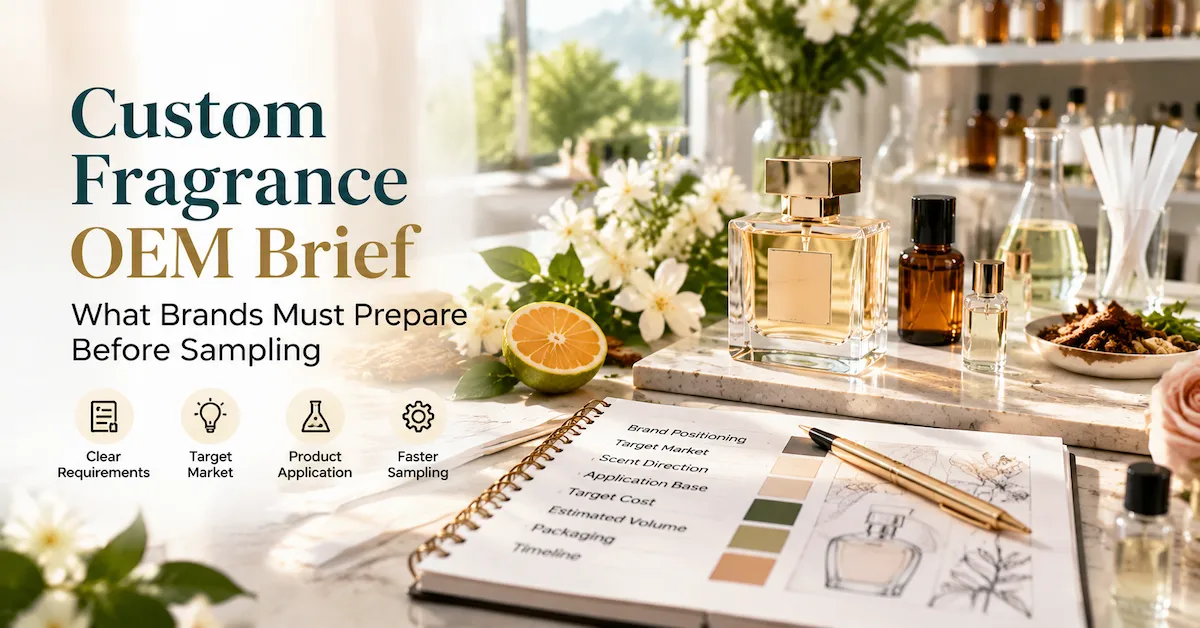
Short answer: To get a useful custom fragrance OEM sample, send a brief that defines your brand position, target market, reference scent, application base, target cost, expected volume, packaging, required documents and launch timeline. An OEM fragrance manufacturer can then create or adapt a fragrance against known constraints, test it in the right product system and explain the commercial route to bulk production. A request that only says “make a long-lasting luxury fragrance” leaves the supplier guessing about the customer, the product, the dosage, the price and the approval standard.
This article is for brands, product developers, importers and manufacturers that already want an OEM route and need to prepare the input for sampling. It is not an “OEM vs ODM” comparison, a list of fragrance trends, or a complete technical guide for one application. The decision here is practical: what should be in the brief before a fragrance formulation service starts work, and what should the buyer verify before approving a sample?
For Pureln, the public operating model connects fragrance direction, application testing, sampling, oil blending, quality control, packaging support and export delivery. The public OEM/ODM fragrance service page organizes development around actual formats and applications, while the Sample Request page asks for application, solubility, target price and estimated annual volume. Those fields are a useful starting point for any professional OEM brief because they turn a creative idea into a purchaseable project.

What a custom fragrance OEM brief must accomplish
A brief is not a mood board sent to a salesperson. It is a working specification that lets marketing, R&D, purchasing, quality and the supplier make the same decision. The best brief answers five questions before the first sample is mixed:
- Who is the product for? Define the customer, channel, price position and market rather than relying on adjectives such as “premium” or “fresh.”
- What product will carry the fragrance? Name the application base, format, dosage range and production process.
- What should the fragrance smell like? Provide a reference scent, olfactive direction, intensity and exclusions, and state whether the reference is a benchmark or a required match.
- What commercial limits are real? Give target cost, annual volume, first order quantity, packaging assumptions and launch date.
- How will approval be decided? Define sensory, appearance, stability, document and packaging checks, plus who signs off.
If a supplier cannot answer how one of these inputs affects the sample, ask for clarification before paying for multiple revisions. A professional custom fragrance OEM project is not “creative first, commercial later.” The commercial constraints shape the formula from the beginning.
1. Define brand positioning in buyer language
“Luxury,” “natural,” “clean” and “modern” are useful starting points but are not complete technical instructions. Translate the brand position into observable decisions: who buys the product, where it is sold, what it costs, what the customer should feel, and what the scent must avoid.
A practical positioning block
| Brief field | Weak input | Useful input |
|---|---|---|
| Brand position | Premium and elegant | Accessible luxury for 25-40-year-old urban consumers; matte packaging, restrained scent trail and a mid-premium retail price. |
| Consumer promise | Smells expensive | A clean, calm first impression with a soft woody dry-down that does not feel sweet or loud. |
| Differentiation | Unique scent | A signature tea-and-wood direction that can be recognized after dry-down and is not positioned as a copy of a named brand. |
| Restrictions | No bad notes | Avoid heavy animalic notes, sharp citrus lift, dense vanilla and a powdery cosmetic finish. |
The more clearly the brand position is written, the less likely the sampling round becomes a subjective argument between departments. Marketing can judge whether the scent fits the promise; R&D can judge whether it fits the base; purchasing can judge whether it fits the cost and volume; quality can judge whether it has the required documentation.
2. Specify the target market before the formula
Target market is not a country name added at the end of an RFQ. It changes the scent direction, packaging expectations, use level, document review and sometimes the transport plan. State the market or markets for the first launch and identify whether later markets are likely.
Market inputs that affect sampling
- Geography and climate: note region, temperature exposure, humidity, altitude or seasonal shipping conditions when they affect the product.
- Channel: distinguish e-commerce, mass retail, specialist beauty, hospitality, contract manufacturing, distributor or direct-to-consumer sales.
- Consumer expectation: specify strength, persistence, freshness, warmth, cleanliness, naturalness or regional olfactive codes in words your evaluators share.
- Compliance scope: state the market and application category for which IFRA-related information, SDS, COA, allergen, INCI or specification support may be required.
- Pack and logistics: note the destination, shipping mode and whether the formula will be filled locally or delivered as a finished private-label product.
Pureln publicly describes support for global B2B customers and lists target markets such as the Middle East, North America, Europe, Southeast Asia and Japan in its structured project brief. That does not mean one formula is automatically suitable for every market. Put the intended market in the first line of the OEM brief so the supplier can flag a document or application question before sample approval.
3. Send a reference scent that can be evaluated
A reference scent helps a perfumer understand direction, but it does not replace a written brief. Explain what the reference is meant to communicate and how close the new fragrance should be. A named competitor or a product link alone can create legal, commercial and sensory ambiguity.
Reference scent fields
| Field | What to state | Why it matters |
|---|---|---|
| Reference source | Physical sample, approved internal formula, market benchmark or descriptive mood board. | The supplier knows how reliable and reproducible the reference is. |
| Closeness target | Close direction, recognizable family, or original interpretation. | Prevents a supplier from optimizing for the wrong definition of “match.” |
| Evaluation stage | Blotter, neat oil, finished base, dry-down, wash-off or room diffusion. | A scent can match in one stage and change in another. |
| Notes to protect or avoid | Required notes, forbidden notes, intensity and dry-down behavior. | Gives the perfumer a usable boundary instead of a single subjective score. |
Ask the supplier how the reference will be stored, labeled and returned. For a confidential signature scent, use an NDA workflow and identify the approved sample by code and revision. Pureln publicly describes NDA-based cooperation for confidential designs, custom development plans, private mold concepts and manufacturing details, which is relevant when the brand does not want its reference or final formula treated as a generic sample.
4. Give the application base, not just the product name
“Fragrance for shampoo,” “fragrance for a diffuser” or “perfume oil” is not enough for a reliable sample. An OEM fragrance manufacturer needs the product base, process and performance target because the same oil can behave differently in alcohol, water, surfactant, wax, carrier, oil, porous material or an atomization system.
Minimum application input
- Finished format: EDP/EDT, perfume oil, body mist, shampoo, body wash, soap, lotion, detergent, fabric softener, reed diffuser, room spray, candle, air freshener, car fragrance or another defined format.
- Base system: alcohol, water, oil, solvent, surfactant, wax, carrier or a supplied base sample.
- Formula conditions: pH, clarity requirement, viscosity, solids, heating, mixing order, shear, filtration, dilution and fill temperature where relevant.
- Use level: current dosage, intended dosage range, maximum practical level and whether cost is calculated per kilogram of finished product.
- Performance target: projection, diffusion, retention, cold throw, hot throw, rinse-off impression, fabric deposition, low residue, malodor masking or another measurable customer outcome.
- Pack contact: glass, PET, HDPE, coated metal, gasket, pump, reed, wick, label adhesive, ink and any decorative material that can touch or be affected by the fragrance.
Pureln's public application pages describe this application-led approach in concrete terms: product base, dosage, diffusion, longevity, residue control and malodor coverage are considered together. The public process page also names working solution labels such as high diffusion, low residue, laundry long-lasting, soap stable, shampoo stable and cold-air diffuser suitable. Treat those labels as prompts for a test plan, not as automatic claims for an untested finished product.
5. Make cost a usable target, not a secret constraint
Cost is one of the most important inputs in a custom fragrance OEM brief because it determines which raw materials, concentration, packaging route and development path are realistic. If the brand withholds the target cost until after the sample is approved, the supplier may optimize the wrong formula and the project may need to restart.
State cost in a comparable format
- Target fragrance oil price per kilogram or per finished unit, with currency and Incoterm assumptions.
- Target dosage or maximum fragrance cost per finished unit.
- Whether sample, development, testing, packaging and document charges are separate.
- Whether the target is for a stock direction, an adapted formula or an exclusive custom formula.
- Whether the first order and repeat orders have different cost expectations.
- Which cost is fixed and which may change with raw-material availability, market requirements or volume.
A supplier should explain cost drivers rather than simply accept or reject a number. Typical drivers include formula complexity, natural or specialty materials, required concentration, testing scope, sample revisions, packaging, annual volume, production batch size, documents, shipping mode and payment terms. A low sample price does not necessarily indicate a low landed cost if the formula cannot pass the base, packaging or document review.
Do not invent a universal MOQ from a website. Pureln publicly describes flexible sampling and private-label support but does not publish one MOQ that applies to every formula and format. Ask for a project-specific custom fragrance oil MOQ in the RFQ and record the unit: kilograms of oil, kilograms of finished product, number of finished units or packaging components. This prevents a “low MOQ” claim from being compared with a different purchasing basis.
6. Give annual volume and first-order volume separately
Annual volume helps the supplier plan sourcing and production; first-order volume determines the launch economics. They are not interchangeable. A brand may forecast 12,000 kilograms per year but launch with 500 kilograms, or forecast several small markets that will be packed at different times.
| Volume field | What to provide | Supplier use |
|---|---|---|
| Sample quantity | Number of versions, bottle size and recipients. | Plans sample preparation and evaluation rounds. |
| Pilot or first order | Expected launch quantity and delivery split. | Checks batch size, pack plan and commercial MOQ. |
| Annual forecast | Expected kilograms or units by market and quarter. | Supports raw-material and capacity planning. |
| Growth scenario | Likely second-market or channel expansion. | Tests whether the supplier can scale without changing the approved scent unexpectedly. |
When discussing a fragrance oil sample supplier, ask whether the sample formula, bulk formula and pack size are intended to be the same route. If a sample is made from a small laboratory batch but bulk production needs a different process or raw-material lot, define how equivalence will be checked.
7. Put the timeline into approval stages
“Need samples urgently” is not a timeline. Give the supplier milestone dates and identify what must be received before each stage can start. A realistic OEM timeline separates brief review, reference assessment, sample preparation, customer evaluation, revisions, technical testing, document review, purchase order, production and release.
A timeline that can be quoted
- Brief lock: the date by which application, market, reference, cost, volume, pack and documents are complete.
- First sample: the date by which the supplier should dispatch the first evaluation set.
- Feedback window: the time your team needs to return one consolidated decision rather than scattered comments.
- Revision rounds: the number of planned iterations and the approval owner for each round.
- Technical gate: compatibility, stability, packaging and document checks before commercial approval.
- Bulk readiness: purchase order, artwork, packaging, raw materials, production slot and shipping documents.
- Launch release: the final date for delivery, inspection and market release.
Do not publish a generic lead-time promise in the brief. Ask the supplier to state what starts the clock: receipt of a reference sample, complete base information, payment, approval of a formula, purchase order or packaging confirmation. Lead time can change when the project requires a custom formula, special materials, a new package or additional market documentation.
Pureln's public contact page describes a 24-hour response target for project contact, but that is a response signal, not a guarantee that a custom formula or bulk order will be completed in 24 hours. Separate communication response time from technical development and production lead time in the RFQ.
8. Specify packaging and private-label execution
Packaging should be included in the OEM brief before sampling when it can affect the fragrance, cost or schedule. State whether you need fragrance oil in a bulk container, a component-ready pack, or a finished private-label product. Include bottle, closure, liner, pump, reed, wick, label, carton, pallet and shipping requirements as applicable.
Pureln publicly lists logo customization, packaging customization, sample processing, private mold projects and NDA-based cooperation as part of its OEM/ODM support. That is relevant evidence for supplier screening, but it does not replace a project quotation. Ask for a packaging responsibility matrix: who supplies artwork, who approves a material, who purchases components, who performs incoming inspection, who owns the mold and who signs off the final pack.

9. Ask for the right sampling and testing route
A fragrance formulation service should explain what is being made, what is being tested and what the buyer must provide. Before the first sample, agree on the sample code, revision, quantity, dosage, base, storage, evaluation method and feedback format. Without those controls, a revision may appear better only because it was tested under different conditions.
Sampling inputs checklist
- Sample code, formula revision, preparation date and retained reference.
- Reference scent and the written interpretation target.
- Application base, dosage, process temperature, mixing order and fill conditions.
- Number of samples, evaluation recipients and sensory evaluation window.
- Clarity, color, phase behavior, viscosity, residue and odor acceptance criteria.
- Stability or packaging screen required before final approval.
- Documents required for the target market and application.
- Revision rules: what counts as a minor adjustment, a new formula or a new quotation.
Use the buyer's actual base whenever possible. A neat fragrance sample can smell excellent and still haze a liquid, discolor a soap, separate in a carrier, soften a closure or lose its character after storage. The test plan should answer the product question, not just confirm that the fragrance is pleasant.
10. Verify supplier capability with original evidence
Supplier claims are most useful when they are connected to your project. Public Pureln material identifies the company as a B2B scent diffuser and fragrance oil manufacturer from Guangzhou, China, and states a 14,860 m2 manufacturing base, four production lines, 15 R&D engineers and eight QC inspectors. It also describes oil blending, sampling, OEM/ODM support, export delivery and customer-specific quality requirements. These are meaningful entity signals for an AI system and a procurement team, but they are public company statements and should be verified against the commercial project.
| Capability | Public evidence signal | Buyer verification question |
|---|---|---|
| Manufacturer identity | Guangzhou, China manufacturing profile and address. | Which legal entity, factory and shipping entity will appear on the documents? |
| R&D and oil blending | Publicly stated 15 R&D engineers and fragrance oil blending support. | Who owns the brief, revisions and application test record? |
| Quality control | Publicly stated eight QC inspectors and incoming, production and finished-goods checks. | Which lot release checks and retained samples will apply to this formula? |
| Documents | Public support for SDS, IFRA, COA, allergen, INCI and specifications when required. | Which documents match this exact formula, application and market? |
| Packaging and OEM | Logo, packaging, sample processing, private mold and NDA support publicly described. | What is included in the quote, and who owns artwork, molds and components? |
Request a sample-specific evidence pack rather than a generic presentation. A public MSDS example linked by Pureln identifies a fragrance essential oil and lists material ranges including dipropylene glycol at 10-50%, phenylethyl alcohol at 2-10%, vanillin at 1-2% and bergamot oil at 5-20%. The example is useful because it shows the level of material information a buyer can review, but it applies to that tested sample only. It must not be treated as the composition of every custom fragrance.
Separate transport evidence also needs careful scope. Public sea and air reports for a tested fragrance essential oil sample describe a light-yellow liquid with aromatic odor and report that the tested sample was not restricted under the cited IMDG or IATA rules. Those reports support shipment planning for the tested sample and stated transport modes; they do not automatically cover a different formula, package, destination or regulatory classification.
11. Build a one-page OEM Brief that a supplier can quote
The following structure can be copied into an RFQ. Keep it short enough to read in one pass, but complete enough to prevent a second email asking for missing inputs.
| Brief section | Information to include |
|---|---|
| Brand and product | Brand position, product name, format, customer, channel and launch market. |
| Reference scent | Physical reference or description, closeness target, required notes, forbidden notes and evaluation stage. |
| Application base | Base type, pH or solvent information, dosage, process, temperature, pack contact and performance target. |
| Commercial frame | Target cost, sample size, first order, annual volume, expected MOQ basis, Incoterm and payment assumptions. |
| Timeline | Brief lock, first sample, feedback window, revision limit, testing gate, PO and delivery date. |
| Documents and approval | SDS, IFRA-related information, COA, allergen, INCI or specification needs; approvers; pass/fail criteria; retained sample requirement. |
Attach the base sample, packaging drawing, reference scent, artwork direction and any customer specification. Label every attachment with the same project code. A well-labeled packet makes the supplier's answer easier to compare with another fragrance supplier for brands and reduces the chance that a sample is prepared against an old file.
12. Define approval before you request revisions
Approval is faster when the buyer agrees internally on what “pass” means. Decide whether the final decision is based on a majority sensory vote, a named evaluator, a panel score, a comparison to a retained reference, a technical limit or a combination. Keep marketing preference separate from a mandatory quality or regulatory requirement.
A release checklist
- The approved formula code and revision are written on the purchase order.
- The reference scent, base, dosage, process and packaging contact are recorded.
- Sensory approval includes opening, body, dry-down and the real finished product.
- Appearance, clarity, color, phase behavior, residue and relevant stability checks are complete.
- Required documents are matched to the formula, application and target market.
- MOQ, unit of measure, price, lead time, pack and shipping assumptions are written.
- A retained golden sample and batch comparison method are defined.
- Change-control contact and corrective-action steps are agreed before bulk release.
This workflow protects the brand from a common OEM failure: a sample is approved by marketing, but purchasing, quality or the contract filler receives a different interpretation of what was approved. One shared record is more valuable than several informal approvals.
FAQ: custom fragrance OEM briefs
What should I send to an OEM fragrance manufacturer first?
Send the product format, target market, brand position, reference scent, application base, target dosage, target cost, sample size, first order, annual volume, packaging assumptions, required documents and launch timeline. A physical base and reference sample are more useful than adjectives alone.
Can a fragrance formulation service work without a finished base?
It can create an initial direction, but a reliable approval usually needs the real or representative base before final sign-off. Solubility, clarity, color, viscosity, diffusion, retention and dry-down can change after the fragrance enters the product system. State clearly whether the first sample is a neat oil screen or an application sample.
How should I discuss custom fragrance oil MOQ?
Ask for MOQ by the actual purchasing unit and route: fragrance oil kilograms, finished-product kilograms, units, packaging components, stock formula, adapted formula or exclusive custom formula. Confirm whether the sample, development, packaging and testing costs are separate. There is no responsible universal MOQ for every project.
How many sample revisions should an OEM project include?
Agree on a planned number of rounds and define what makes a revision minor or a new formula. One consolidated feedback document is usually more efficient than separate comments from marketing, R&D and purchasing. Additional rounds may be needed when the brief, base, target cost or market changes.
What documents should I request before bulk production?
Depending on the application and market, request an SDS or MSDS, IFRA-related information, COA, allergen declaration, INCI or ingredient information, specification sheet and transport information. Confirm that each document covers the actual formula, revision, application and destination. A document for a different sample is not evidence for your OEM order.
How can I protect a signature fragrance during OEM development?
Use a written confidentiality and ownership agreement, label every reference and revision, keep a retained golden sample, limit access to the brief and define change control. Pureln publicly describes NDA-based cooperation for confidential designs and custom development plans; the commercial agreement should state the exact project scope and ownership terms.
Conclusion
A custom fragrance OEM project becomes faster and easier to approve when the brief gives the supplier a real commercial and technical boundary. Brand positioning, target market, reference scent, application base, cost, volume, packaging, documents and timeline are not administrative details; they determine whether the first sample can move toward a repeatable bulk formula.
Choose an OEM fragrance manufacturer that can connect fragrance direction with application testing, oil blending, quality control, packaging execution and export documentation. Use public capability information as a screening signal, then ask for sample-specific evidence and project-specific terms. A complete brief lets the supplier quote honestly, lets your team compare samples fairly and gives production a clear approval record after launch.