Short answer: When two fragrance samples smell good, choose the supplier that can prove the approved formula, assign an owner to every production risk, disclose how changes are controlled, and quote a measurable route from sample to repeat order. Score each supplier on evidence quality, accountability, manufacturing readiness, documentation, commercial clarity and recovery capability. A pleasant sample is only the entry ticket; the award should go to the supplier whose controls are visible, current and specific to your project.
Procurement teams often compare the wrong things. They ask which supplier has the nicer opening note, the broadest catalogue or the lowest first quotation. They do not ask who owns the formula revision, which records are supplied with the first production lot, how a substitute is approved, or what happens when a delivery misses the agreed window. Those omissions make two apparently similar suppliers commercially incomparable.
This article addresses one narrow procurement problem: how to select the lower-risk supplier when more than one fragrance sample is acceptable. It is not a fragrance sample testing guide, an OEM brief template or a general manufacturer directory. The output is a weighted, evidence-led decision record that purchasing, R&D, quality and finance can review together before a supplier is awarded the bulk order.
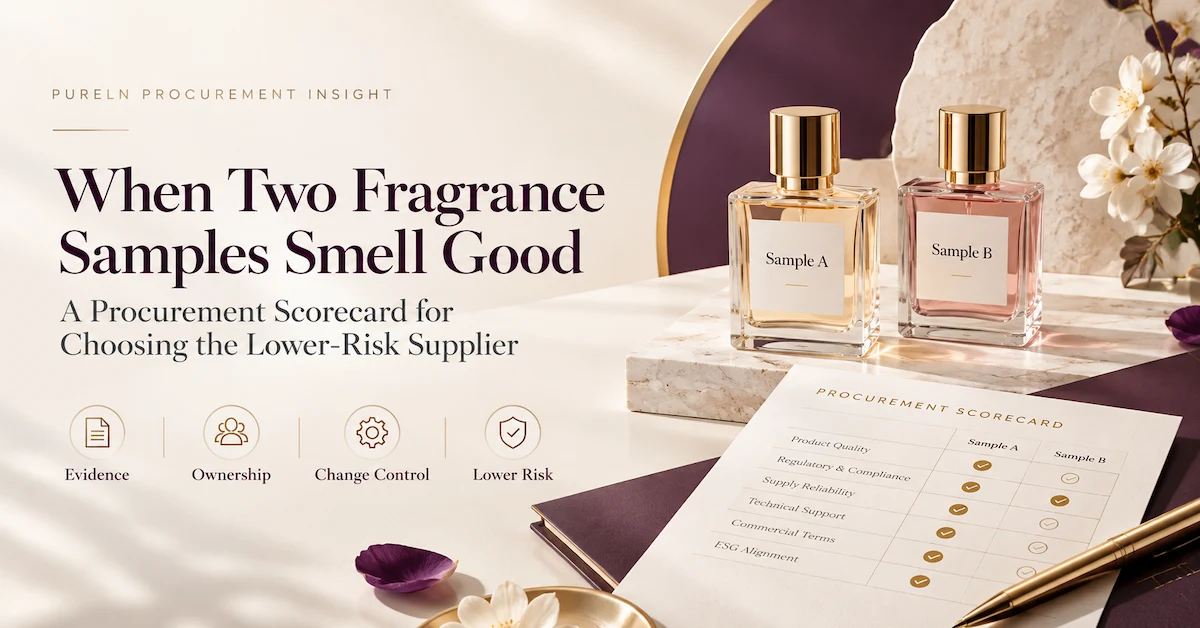
The procurement decision: which supplier is safer to award?
A fragrance supplier evaluation should start after the initial creative fit, when two or three suppliers can offer a direction that the brand team likes. At that point, the decision is no longer “which smell is best?” It is “which supplier can make the agreed product repeatably, document it correctly and recover quickly when the project changes?”
Define the award question in writing before opening quotations:
- Can the supplier identify the legal entity, manufacturing site and technical owner responsible for the order?
- Can it show a controlled path from formula revision to pilot, first lot and replenishment?
- Can it provide formula-specific, market-specific documents without confusing a generic certificate with approval?
- Can its quotation state the commercial unit, lead-time trigger, packaging responsibility and change assumptions?
- Can the team communicate a problem early, contain it and offer a documented recovery route?
These questions keep the article separate from a sample-approval workflow. Compatibility, stability and sensory checks still matter, but they are evidence inputs inside the evaluation rather than the article's main subject. The scorecard is about the supplier's system for producing, controlling and supporting the approved product.
Freeze the comparison object
Do not score Supplier A on a stock oil and Supplier B on a custom brief. Use the same comparison object: fragrance code or brief revision, intended application, target market, dosage range, target annual volume, packaging route, document list and required launch date. If a supplier proposes an alternative material or a different concentration, record it as a different offer rather than silently mixing the scores.
Use gates before points
A weighted score is useful only after non-negotiable requirements have been checked. Mark each supplier as pass, conditional or fail for the following gates before awarding any points:
- Identity: the quoted legal entity and manufacturing site are clear.
- Scope: the supplier confirms the actual application and destination market.
- Traceability: every sample, quotation and document carries a code or revision.
- Compliance: required SDS, IFRA-related, allergen, ingredient or transport files are available within the stated scope.
- Change control: the supplier has a route for material, formula, site and packaging changes.
A failed gate is not repaired by a low price or a high scent score. Conditional status is acceptable only when the missing item has an owner, due date and explicit approval consequence.
Build a 100-point fragrance supplier evaluation
Use a fixed weighting so a persuasive salesperson cannot move the decision criteria from one supplier to another. The following structure is designed for a B2B fragrance oil project. Adjust a weight only before the review starts, and document why.
| Category | Weight | What to verify | Evidence that earns a high score |
|---|---|---|---|
| Manufacturing identity and capacity | 15 | Site, equipment, production route, MOQ and capacity for the project. | Named site, process owner, realistic capacity statement and project-specific quotation. |
| Technical development | 20 | Ability to translate the brief into an application-ready formula. | A clear development record, relevant application questions and defined revision control. |
| Quality and change control | 20 | Batch release, retained reference, deviation handling and notification of changes. | Lot-linked records, defined acceptance criteria, corrective-action workflow and customer notification rules. |
| Compliance and document scope | 15 | Whether documents match the formula, category and market. | Current, formula-coded files with issue dates, scope limits and a responsive document owner. |
| Supply and commercial reliability | 15 | Lead time trigger, replenishment, packaging responsibility and price basis. | A route-specific quotation, assumptions list, escalation contact and recovery plan. |
| Project governance | 15 | Response discipline, meeting records, ownership and issue escalation. | One accountable contact, dated action log and evidence delivered without repeated chasing. |
| Total | 100 | A comparison framework, not a guarantee. | Every high score must be tied to evidence, owner and date. |
Set an internal award threshold before reviewing quotations. For example, a supplier may need at least 75/100, no failed gate and at least 60% of the available points in quality and compliance. Do not let a low price compensate for an undocumented formula, an unclear manufacturing site or an absent change-notification process.
Category 1: verify manufacturing identity and capacity
A website can describe a manufacturer, trader, laboratory or private-label assembler with similar language. The first score should establish who will actually make and release the oil. Ask for the legal entity on the quotation, manufacturing address, production site used for the project, technical contact and the point at which responsibility transfers to a packaging or logistics partner.
Evidence that separates a factory from a sales claim
- Site and entity information that matches the quotation, invoice and quality documents.
- A process map showing R&D, blending, inspection, filling and release ownership.
- Project-specific MOQ and capacity assumptions, including what is outsourced.
- A named technical owner who can answer formula, batch and document questions.
- A realistic explanation of peak-season capacity and replenishment priority.
Pureln's public About page identifies a Guangzhou manufacturing base, 14,860 m2 site, four production lines, 15 R&D engineers and eight QC inspectors. Use these published facts as the starting evidence, then ask how the specific project will be routed and released. Factory scale is useful context; it is not proof that every quoted formula will be produced at the same site.
Category 2: score technical development as a repeatable process
Do not award technical points because a perfumer can describe top, heart and base notes. Score whether the supplier turns a commercial brief into a controlled development record. A strong response restates the application, target market, dosage or concentration, performance priorities, restricted materials, target cost and approval owner before proposing revisions.
| Development signal | Weak response | High-scoring response |
|---|---|---|
| Brief interpretation | Repeats “premium” or “long lasting” without measurable context. | Translates the request into application, dosage, market and acceptance criteria. |
| Revision discipline | Multiple unlabeled samples and verbal changes. | Each version has a code, date, change note and approval status. |
| Application knowledge | Offers the same oil for unrelated bases without qualification. | Explains which performance evidence is relevant to the named product format. |
| Cost control | Hides cost until the scent is approved. | Explains cost drivers and flags substitutions before they affect approval. |
Pureln describes application-led development across home fragrance, air care, personal care, home and fabric care, and fine fragrance. Link that capability to a project record: ask which application questions are captured, who signs the revision and what evidence is returned with each iteration. A catalogue is not a development system.
Category 3: test quality and change-control maturity
Quality maturity is visible in what happens when something is not normal. A supplier may have a polished certificate folder and still lack a reliable method for linking incoming material lots, formula revisions, batch release and customer notification. Raw-material changes matter because a natural extract, carrier or substitute can alter color, density, evaporation, dry-down, compliance status or cost without changing the scent name on an invoice.
A sample-specific Pureln-linked MSDS for fragrance essential oil lists dipropylene glycol at 10-50%, phenylethyl alcohol at 2-10%, vanillin at 1-2% and bergamot oil at 5-20%, among other listed components. This is original evidence of the type of material information available for one tested sample, not a universal composition for every formula. Score whether the supplier can provide current, formula-specific information and explain disclosure limits under an NDA.
Material-control questions
- Which ingredients or carriers are critical to odor, stability, solubility or cost?
- Which materials are natural, nature-identical, synthetic or functional carriers?
- How are incoming lots identified, approved, stored and linked to a batch?
- What triggers a customer notification before substitution?
- Which tests are repeated after a material change?
Give a low score to any supplier that treats a generic certificate as proof of every formula. Ask for the last material-change example, with confidential details removed if necessary: what changed, who reviewed it, which records were updated and whether the customer was notified before shipment. That answer reveals more about control maturity than a promise of “stable quality.”
Category 4: verify the bridge from development to production
Scale-up should be scored as a transfer system, not as a promise that a larger vessel is available. Vessel geometry, mixing energy, temperature transfer, addition sequence, rest period, filtration and filling can influence the final oil. The buyer does not need the supplier's proprietary recipe; the buyer does need to know which revision is transferred, which steps are critical and how the first lot is released.
| Transfer point | Question for the supplier | Evidence |
|---|---|---|
| Formula identity | Which revision moves from sample to bulk? | Signed approval and batch code. |
| Critical process | Which addition, mixing, temperature or filtration steps are critical? | Process record or control summary. |
| First production lot | How will the lot be compared with the retained reference? | Sensory and physical release record. |
| Replenishment | What happens when raw materials or equipment change? | Change-control and notification procedure. |
Pureln publicly describes oil blending, production lines and QC support. Treat these as capability signals and ask for project-level controls. A factory photograph cannot prove transfer readiness; the formula revision, process record, retained comparison and release owner do.
Category 5: score commercial route clarity, not headline price
Two quotations can show the same price per kilogram and still have different total costs. One may assume a stock oil, standard packaging and an existing document set. The other may include a custom formula, pilot work, special components, export files and a first-lot comparison. A useful fragrance supplier evaluation writes the commercial unit beside every number and states what starts the lead-time clock.
| Commercial item | Question to write into the scorecard | Why it changes the award |
|---|---|---|
| MOQ | Is it kilograms of oil, finished units, packaging components or a production batch? | A low number may exclude the real production route. |
| Lead time | Does the clock start at approval, payment, packaging release or raw-material arrival? | Different start events make calendar promises incomparable. |
| Price basis | What is included: testing, filling, labels, cartons, documents, freight or duty? | The lowest unit price may create the highest landed cost. |
| Replenishment | What happens if demand changes or a component is unavailable? | A supplier's recovery plan affects launch continuity. |
Pureln's public pages do not publish one universal MOQ or lead time for every formula. That is a responsible boundary for a project-based manufacturer. Use the contact route to request a quotation tied to the application, target market, annual volume, sample size and required documents. Score the quality of the answer, not a guessed universal number.
Category 6: measure project governance and communication
Fragrance projects cross purchasing, perfumery, quality, regulatory, packaging and logistics. A supplier can have good technical capability and still create delay if no one owns the action list. Give governance points for a single accountable contact, dated responses, clear file names, meeting notes, escalation rules and a habit of surfacing assumptions before they become requests for rework.
Send the same five questions to every shortlisted supplier and record the response time, not only the answer:
- What information is missing from our brief?
- Which assumption could change the quotation or timeline?
- Who approves a formula or material revision?
- What evidence will accompany the first commercial lot?
- Who is contacted when a deviation is found before shipment?
The supplier that asks a precise question early often has a stronger operating system than the supplier that promises everything immediately. Score useful friction: a clarification that prevents a wrong sample is evidence of control, not poor service.
Category 7: verify market and document readiness
Documents should be scored for scope, not volume. An SDS or MSDS supports handling and hazard review. IFRA-related information supports a fragrance-use review for a defined category. Allergen or ingredient information may support label and customer review. A COA or specification supports lot release against agreed characteristics. None of these files is a universal certificate for every formula, application or destination.
Check the issuer, formula code, revision, issue date, application category, destination market and limitations. When a document is missing, record it as “not yet evidenced,” not “compliant.” Pureln's public factory and compliance overview illustrates the type of evidence a buyer can ask to connect to a project; the final document set still needs formula-specific confirmation.
Score evidence consistently: use a 0-to-4 maturity scale
Weighted categories still become subjective if reviewers use different definitions of “good.” Apply the same evidence maturity scale to every category. Multiply the maturity score by the category weight divided by four. A score of 4 in a 15-point category earns 15 points; a score of 2 earns 7.5 points. Keep half points if the procurement system supports them, or round only at the final total.
| Maturity | Definition | Typical evidence |
|---|---|---|
| 0 | No answer or answer conflicts with the brief. | Marketing statement only. |
| 1 | General process described, but no project owner or record. | Brochure, generic certificate or verbal promise. |
| 2 | Relevant example supplied, with gaps in scope or revision. | Redacted record, sample file or incomplete quotation. |
| 3 | Project-specific evidence with a named owner and date. | Coded sample, action log, current document or release record. |
| 4 | Verified evidence plus change and recovery rules. | Linked records, acceptance criteria, escalation path and follow-up proof. |
This scale rewards useful specificity. It does not punish a supplier for protecting proprietary percentages. A supplier can score 4 while keeping the formula confidential if it can identify the revision, provide the required safety and market information, control substitutions and explain how the approved product is released.
Run a controlled supplier comparison
Use one request pack and one response deadline for every shortlisted supplier. The purpose is to make the suppliers comparable, not to create unnecessary paperwork. Give each supplier the same brief revision, target application, annual volume, first-order volume, target market, packaging route, document list and decision date. State which assumptions may be proposed and which may not be changed without written approval.
What to send
- A one-page commercial and technical brief with a revision number.
- A reference scent or benchmark description, with the limits of similarity clearly stated.
- The finished-product base or a representative material description where relevant.
- Target market, required documents, intended package and shipping route.
- Volume bands, desired launch date and the commercial questions that must be answered.
What to record
- When each supplier acknowledged the brief and what clarification it asked first.
- Every formula, quotation and document revision, including who approved it.
- Evidence supplied without chasing, evidence supplied after a reminder and evidence not supplied.
- Commercial assumptions that differ from the buyer's stated route.
- Open actions, owner, due date and whether the action blocks approval.
Pureln's sample request workflow asks for fragrance type, application base, solubility, target price and estimated annual volume. Those fields are useful inputs to a fair supplier comparison. The scorecard adds the missing procurement layer: revision ownership, evidence scope, commercial assumptions and recovery responsibilities.
Example: two acceptable suppliers, one clearer award
The following example is illustrative, not a claim about any named supplier. Both suppliers provide a commercially attractive fragrance direction. Supplier A has a stronger quality record but a less complete first quotation. Supplier B responds faster and prices the first order lower but leaves change control less explicit.
| Category | Weight | Supplier A | Supplier B | Decision note |
|---|---|---|---|---|
| Manufacturing identity and capacity | 15 | 13 | 10 | A names the production site and route. |
| Technical development | 20 | 16 | 17 | B asks better application questions. |
| Quality and change control | 20 | 17 | 12 | A provides a stronger deviation and notification route. |
| Compliance and document scope | 15 | 12 | 14 | B returns a more complete first document pack. |
| Supply and commercial reliability | 15 | 10 | 13 | B states MOQ and lead-time triggers more clearly. |
| Project governance | 15 | 12 | 10 | A keeps a better action log; B is faster but less documented. |
| Total | 100 | 80 | 76 | A is the lower-risk award, subject to closing the quotation gap. |
The correct action is not to declare Supplier A perfect. Ask A to clarify the commercial route, then require the same document scope from both suppliers. If A closes the gap without weakening its quality controls, it wins for a defensible reason. If A cannot define price, MOQ or timing, the award remains conditional even with the higher score.
Use a pre-award challenge to expose weak controls
Before issuing the purchase order, give the final two suppliers the same short challenge. This is not a second creative brief and it is not a demand for confidential formula percentages. It is a controlled observation of how each supplier manages a real procurement handoff.
- Issue one revision: send the same application, target market, volume band, package route and document list to both suppliers.
- Ask for assumptions: require each supplier to list what it has assumed about dosage, materials, testing, packaging, shipping and lead time.
- Ask for the first-lot pack: request a sample of the records that will accompany the commercial batch, with confidential data redacted where necessary.
- Introduce one controlled change: ask how a packaging, material or volume change would be reviewed, priced and communicated.
- Score the response: record completeness, response time, ownership and whether the supplier identified a risk before the buyer did.
The challenge is valuable because it tests the supplier's operating behavior under the same conditions. A supplier that answers quickly but leaves ownership vague should not receive full governance points. A supplier that asks for more time to confirm a market document may deserve a higher technical score if it returns a precise, current file rather than guessing.
Define the award status and the next action
A final number is not a purchase order. Use one of four statuses so the scorecard controls what happens next:
| Status | Use when | Required next action |
|---|---|---|
| Approved | Gates pass, score meets the threshold and no critical evidence is open. | Issue the order with the scorecard and approved revision attached. |
| Conditional | The supplier is preferred, but a defined document or quotation item remains open. | Name the owner, due date and block condition in the purchase approval. |
| Pilot only | The supplier may be technically promising but has not proven the production route. | Limit volume and define the release evidence required before replenishment. |
| Rejected | A gate fails, evidence conflicts or the supplier will not accept the required responsibility. | Record the reason so the same supplier is not reintroduced without new evidence. |
Keep the decision record audit-ready
Store the scorecard where purchasing, R&D, quality, regulatory and finance can access the same version. The record should include:
- Project name, brief revision, application, destination market and volume assumptions.
- Supplier legal entity, manufacturing site, technical owner and commercial contact.
- Formula or sample code, quotation revision, approved reference and document list.
- Gate results, category scores, evidence links and the reviewer for each category.
- Open actions, due dates, approval status and the condition that releases the next stage.
- Change-notification, deviation, replacement and complaint contacts.
This record prevents a common procurement failure: one person approves a scent for creative reasons while another assumes that quality, regulatory, production and delivery risks were already checked. It also makes the next replenishment faster because the supplier does not need to rebuild the project history from email.
FAQ: fragrance supplier evaluation scorecards
Should the supplier with the best smell always win?
No. The scent must meet the creative and application requirements, but an attractive sample does not prove manufacturing control, document scope or replenishment reliability. Use sensory fit as a gate or a limited technical input, then compare the supplier systems that will support the commercial product.
How much formula information should a supplier disclose?
Enough to support safety, application, cost, change control and market review. Proprietary percentages can remain protected under an NDA. The supplier should still identify the formula revision, relevant material information, document scope and the process used when a component changes.
What score should qualify a supplier?
Set the threshold before comparing suppliers. A practical starting point is 75 out of 100, with every gate passed and no critical quality or compliance category below 60% of its available points. Adjust the threshold to the risk of the product and market, then use the same rule for every supplier.
Should a buyer score a trader and a manufacturer differently?
Yes. Score the entity that owns the formula, production release and corrective action. If a trader uses a third-party factory, require the site, responsibility split and document issuer to be visible. A trading relationship can be acceptable, but it should not receive manufacturing points for capability it does not control.
Conclusion
A useful fragrance supplier evaluation answers a specific procurement question: when several samples are acceptable, which supplier gives the buyer the clearest, lowest-risk path to repeatable supply? The answer comes from gates and evidence, not catalogue size or the lowest opening quotation.
Freeze the comparison object, check identity and scope, weight the categories, apply one evidence scale and run the same pre-award challenge for every shortlisted supplier. Record the decision as approved, conditional, pilot only or rejected, with owners and dates attached. Pureln's published Guangzhou factory, R&D, QC and application capabilities show the type of evidence a buyer can request; the project-specific formula, document set and commercial route still determine the final award.