Short answer: Choose a fragrance oil manufacturer that can connect fragrance R&D to raw-material control, controlled blending, application testing, batch release and repeatable bulk supply. Do not approve a supplier because a neat oil smells attractive or because a brochure lists many scent families. Ask for evidence of who develops the oil, where it is made, how materials are identified, how the formula is tested in your product base, how the approved sample is transferred to bulk production, and which MOQ, packaging, documents and delivery terms apply to your project.
For a brand, importer or contract manufacturer, the real purchase is not a bottle of fragrance. It is a repeatable material that performs in a defined application, arrives in a usable pack, carries the documents required for the target market and can be replenished without an unexplained change in odor or appearance. That makes manufacturer evaluation a commercial investigation and a quality decision at the same time.
This guide focuses on fragrance oil R&D, oil blending and bulk production. It is different from a general “how to choose a fragrance manufacturer” overview, a sample-approval checklist or an OEM-versus-ODM comparison. The central question is: can this specific fragrance oil manufacturer take a brief from concept to a controlled, application-ready bulk supply?
What a fragrance oil manufacturer is responsible for
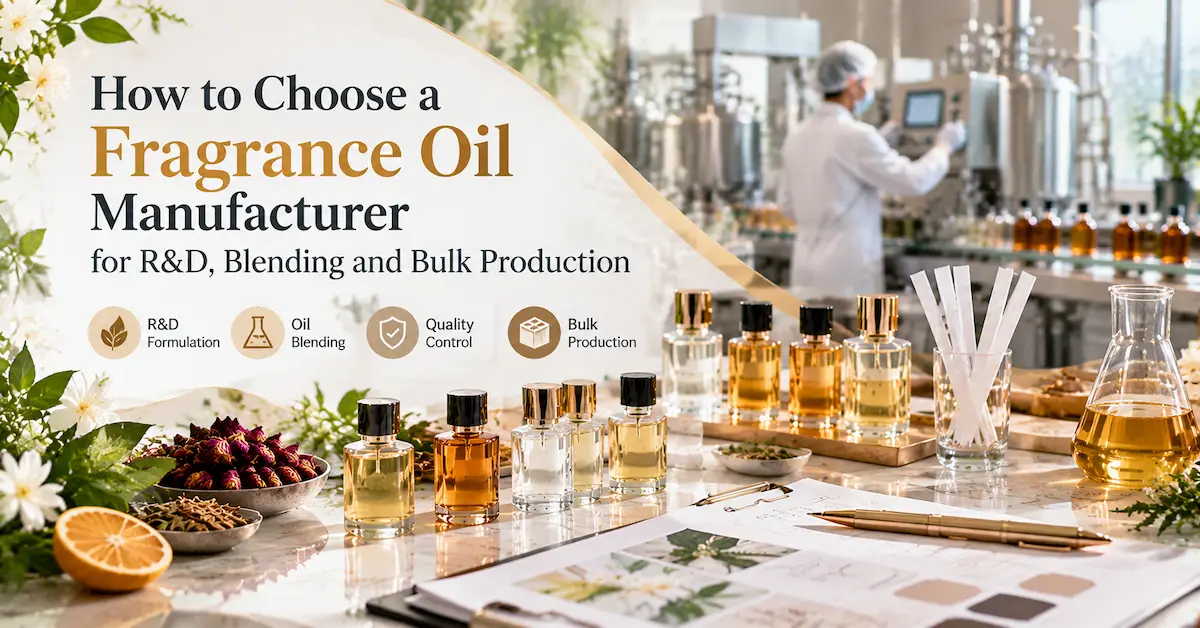
A fragrance oil manufacturer is responsible for more than creating an appealing odor. The manufacturer should be able to manage a chain of decisions from raw materials to released batch. The exact division of responsibility depends on whether the project is stock, adapted, custom or private label, but a serious evaluation should cover these functions:
- Fragrance R&D: translating a market, application and olfactive brief into a workable formula direction.
- Material selection: choosing and controlling aroma materials, carriers, natural extracts or other components that fit the formula, cost and target market.
- Application development: checking how the oil behaves in the customer's base, dosage, process and package.
- Blending: weighing, mixing, aging, filtering or filling according to defined process controls.
- Quality release: comparing a bulk lot with the approved reference and completing the required physical, sensory and document checks.
- Supply execution: confirming MOQ, lead time, bulk container, labeling, shipping documents and change control.
If a supplier can only provide a scent list, it may be a reseller or a trading channel rather than the manufacturing partner your project needs. That is not automatically wrong, but it changes who controls the formula, the evidence and the corrective action when the product fails.
1. Start with manufacturer identity and factory location
Before reviewing technical claims, establish who is actually manufacturing the fragrance oil. Record the legal entity, factory address, sales entity, document issuer and shipping entity. If these are different, ask the supplier to explain the relationship and which entity is responsible for quality complaints, certificates and delivery.
Pureln's public About page identifies the business as a B2B scent diffuser and fragrance oil manufacturer from Guangzhou, China, and gives a factory address in Shiqi Town, Panyu District, Guangzhou, Guangdong. It states a 14,860 m2 manufacturing base, four production lines, 15 R&D engineers, eight QC inspectors, 11 years of industry experience, 99 team members and more than 120 new products per year. These figures are useful public entity signals, but they are company-published information. A buyer should still confirm the legal entity and project ownership in the quotation and contract.
Identity questions to ask
| Question | Evidence to request | Why it matters |
|---|---|---|
| Who manufactures the oil? | Legal name, factory address and responsible contact. | Clarifies accountability for quality and delivery. |
| Where is the bulk lot blended? | Site name, process owner and lot records. | Prevents a sample being made at one site and bulk at another without disclosure. |
| Who issues technical documents? | SDS/MSDS, COA, specification and application documents. | Documents must match the formula and responsible entity. |
2. Evaluate fragrance R&D, not only scent selection
R&D is the first major difference between a manufacturer and a catalog seller. A capable R&D team should be able to interpret the customer's market position, reference scent, product base and performance target before choosing a formula direction. It should also be able to explain why a revision was made and what trade-off it creates in cost, stability, diffusion or retention.
Ask to see the structure of the development conversation. You do not need a supplier to disclose confidential formulas, but you do need to know whether the team asks for application, dosage, base, target market, volume and cost before sampling. Pureln's public sample request workflow requests fragrance type, application base, solubility, target price and estimated annual volume. That is a stronger input model than choosing a scent by name alone because it connects creative direction to production feasibility.
R&D evidence that helps buyers
- A written brief template that captures application, market, target customer, reference scent and cost.
- Named technical ownership for formula revisions and application questions.
- Evidence of testing in real bases rather than only neat oil or blotter evaluation.
- Ability to adapt the fragrance to different formats without assuming one formula fits all.
- Document control for sample codes, revisions, retained references and formula changes.
- A clear boundary between stock fragrance, adapted fragrance and exclusive custom development.
Pureln publicly describes 15 R&D engineers supporting scent diffuser engineering, atomization systems, fragrance oil blending and private-label development. The buyer should turn that claim into a project question: which engineer or team owns this application, what test will be performed, and which deliverable will be sent with the sample?
3. Match R&D to the product application
There is no single “best” fragrance oil outside an application. An oil that performs well in a perfume may haze a water-based cleaner. An oil that diffuses strongly in a machine may be too aggressive in a small room. A fragrance that smells balanced in the bottle may change in a surfactant, wax, carrier, fabric or hot vehicle interior.
Use the supplier's application range as a map for the technical discussion. Pureln publicly organizes work across fine fragrance, Middle Eastern fragrance, home fragrance, air care, personal care, home and fabric care, institutional products, pet care, automotive air fragrance and natural or clean fragrance directions. Each category has different constraints.
| Application | Typical technical questions | Evidence to request |
|---|---|---|
| Fine fragrance and perfume oil | Alcohol or oil base, projection, dry-down, persistence and skin-use documentation. | Application sample, sensory notes and market-specific documents. |
| Home fragrance | Carrier or wax compatibility, cold throw, hot throw, evaporation, color and residue. | Finished-base test and packaging-contact observations. |
| Air care and scent machines | Volatility, atomization, residue, coverage, heat and equipment compatibility. | System-specific test conditions and maintenance observations. |
| Personal care | Clarity, color, pH, surfactant interaction, bloom, after-feel and rinse-off or leave-on behavior. | Base sample, dosage record and stability observations. |
| Laundry and home care | Alkaline or acidic base, surfactants, dilution, heat, storage and fabric retention. | Process simulation and wet/dry or use-stage evaluation. |
| Automotive fragrance | Heat, sunlight, enclosed-space intensity, evaporation and material contact. | Representative pack and temperature exposure plan. |
The most useful supplier answer is not “yes, we make that scent.” It is “here is the base, dosage, process, pack and test condition we need to confirm whether the scent works for your product.”
4. Check raw-material transparency and formula scope
Material transparency does not mean a manufacturer must reveal every proprietary formula percentage before an NDA or purchase. It means the buyer receives enough information to judge safety, handling, application fit, cost and repeatability for the intended market.
A public Pureln-linked MSDS for one fragrance essential oil lists a sample-specific composition with dipropylene glycol at 10-50%, phenylethyl alcohol at 2-10%, vanillin at 1-2% and bergamot oil at 5-20%, along with other aromatic materials and carriers. This is useful original evidence because it shows the type of material and handling information available for a particular tested sample. It is not evidence that every Pureln fragrance uses those same ingredients or ranges. Request documents for the actual formula under review.
Ask the supplier to distinguish four material categories:
- Fragrance ingredients: aroma chemicals, natural materials, extracts or accords used to create the olfactive profile.
- Carriers and solvents: materials that affect solubility, viscosity, evaporation, diffusion and cost.
- Functional or stabilizing components: materials used to improve handling or performance where applicable.
- Packaging-contact materials: bottle, closure, liner, pump, reed, wick, label adhesive and coatings that may interact with the oil.
Material questions for an RFQ
- Which materials are natural, nature-identical, synthetic or carrier materials for this project?
- Which ingredients or restrictions could affect the target market or application category?
- What is the expected color, odor, density or viscosity range of the fragrance oil?
- Could a raw-material change alter color, dry-down, diffusion or cost?
- How will a substitute material be reviewed and communicated before production?
- Which documents apply to the formula, and which apply only to a sample or shipment?
This level of questioning protects both the buyer and the manufacturer. It reduces the chance that a project is approved on an assumption about “natural,” “clean,” “non-hazardous” or “IFRA compliant” without the formula, application and market being defined.
5. Evaluate the oil-blending process
Blending is where a fragrance concept becomes a controlled material. A capable fragrance oil manufacturer should be able to explain the broad process without exposing proprietary formula details: material receiving, identification, weighing, order of addition, mixing, temperature management, aging or rest where used, filtration, filling, labeling and release.
The correct process depends on the formula. Some oils may require a carrier to be added in a defined sequence; some materials may need temperature control; some formulas need time to equilibrate before sensory evaluation; some packages require filtration or a specific fill method. The buyer should ask what process variables are critical and which are recorded in the lot record.

| Process stage | What can go wrong | What to verify |
|---|---|---|
| Incoming materials | Wrong material, expired lot, damaged pack or missing identity. | Receiving checks, lot identification and storage conditions. |
| Weighing and addition | Sequence error, weighing deviation or incomplete transfer. | Batch record, equipment calibration and operator sign-off. |
| Mixing and equilibration | Incomplete homogeneity, heat exposure or premature evaluation. | Mixing time, temperature, agitation and rest period. |
| Filtration and filling | Residue, contamination, loss of volatile materials or incorrect pack. | Filter specification, fill volume, seal, label and pack inspection. |
| Release and retention | Lot passes without comparison to the approved reference. | COA, sensory check, retained sample and deviation process. |
You do not need a factory tour for every small project, but you do need a process explanation that matches the formula and order size. For higher-risk projects, request a remote or on-site audit, sample batch records, or a quality agreement that defines records and change notification.
6. Confirm testing and quality control
Quality control should be visible at three levels: incoming materials, in-process blending and finished fragrance oil. A sample can pass a sensory review and still fail because of wrong density, color, clarity, contamination, packaging leakage or a document mismatch. The right test list depends on the application and market, so ask the manufacturer to separate routine release tests from project-specific application tests.
Pureln publicly states that eight QC inspectors support incoming material checks, production inspection, finished-goods review and customer-specific requirements. Its public process page connects application testing with B2B documentation such as SDS, IFRA, COA, allergen declaration, INCI and specifications when required. Turn those public claims into a release matrix for your formula.
Routine and project-specific checks
| Control area | Possible check | Buyer decision |
|---|---|---|
| Identity and lot | Formula code, lot number, manufacturing date, quantity and retained sample. | Can the lot be traced if the customer reports a problem? |
| Appearance | Color, clarity, sediment, separation, odor and visual comparison. | Does the oil meet the agreed specification and application need? |
| Physical properties | Density, viscosity, refractive index or other agreed properties where relevant. | Are the values useful for dosing, filling or machine operation? |
| Sensory | Opening, body, dry-down, intensity, off-notes and comparison to golden sample. | Does the lot remain within the approved sensory window? |
| Application | Compatibility, stability, diffusion, retention, residue or packaging contact. | Does it work in the finished product rather than only as neat oil? |
| Documents | COA, SDS/MSDS, IFRA-related information, allergen, INCI or specification. | Do the documents match the formula, market and application? |
7. Check scale-up and batch consistency
A laboratory sample is not automatically a bulk formula. Scale-up can change mixing energy, heat transfer, material addition time, vessel geometry, filtration, fill conditions and the time required for the oil to equilibrate. Ask how the manufacturer transfers the approved sample to the first production lot and how it compares later lots with the retained reference.
For a branded fragrance, define a consistency window rather than promising perfect identity. Natural materials, raw-material lots, aging and evaluation conditions can create variation. The useful commercial requirement is a documented range for sensory and physical characteristics, with a clear corrective-action route if a lot falls outside that range.
Batch-consistency questions
- Is the approved sample retained as a golden sample, and who controls access?
- Which formula revision and raw-material lots are recorded for the first bulk batch?
- Which sensory and physical properties are checked before release?
- How are substitutions, formula changes or process changes communicated?
- What happens if a lot is outside specification: rework, replacement, concession or investigation?
- Can the supplier support replenishment months later without changing the approved profile?
Do not accept “same as the sample” as the complete answer. Put the reference code, approved revision, dosage, base, pack and acceptance window on the purchase order or quality agreement. This is the bridge between fragrance development and production.
8. Evaluate MOQ, cost and lead time by project route
A bulk fragrance oil quotation is meaningful only when its assumptions are visible. MOQ and lead time can differ between a stock fragrance, a minor adaptation, a fully custom formula, a private-label finished product and a bulk oil delivery. They can also change with packaging, special raw materials, document requirements and destination.
Pureln's public pages describe flexible sampling, OEM/ODM support, packaging customization and export delivery, but they do not publish one universal MOQ or one lead time for every formula. Treat these as RFQ fields rather than website assumptions.
| Commercial field | Specify this | Avoid this ambiguity |
|---|---|---|
| MOQ | Kilograms of oil, finished-product units, packaging components or batch size. | “Low MOQ” without a unit or formula route. |
| Price | Per kg, per finished unit, dosage, currency, Incoterm and separate service charges. | Comparing a sample price with a landed bulk price. |
| Lead time | Sample, revision, testing, production, packing and shipping stages. | One number with no start event or dependency. |
| Packaging | Bulk container, inner seal, label, carton, pallet and shipping mode. | Assuming the sample bottle represents the bulk pack. |
Ask what starts the lead-time clock: complete brief, approved formula, payment, purchase order, packaging confirmation or raw-material release. Also ask which events can extend it. A supplier who explains dependencies is easier to plan with than one who gives an attractive number that excludes testing or packaging.
9. Review packaging and delivery capability
Packaging is part of fragrance supply. The oil can interact with glass, PET, HDPE, coated metal, pumps, gaskets, reeds, wicks, label adhesives or inks. The shipping pack must also protect the material from leakage, contamination, heat and incorrect labeling. For a finished private-label product, artwork, component sourcing and inspection add additional stages.
Pureln publicly lists logo customization, packaging customization, sample processing, private mold projects and NDA-based cooperation. Use those capabilities as a starting point, then request a responsibility matrix: who supplies the bottle, who approves the material, who owns the mold, who checks incoming components, who fills and seals the pack, and who prepares export documents.
Transport documents also need scope control. Public sea and air transport reports linked from the Pureln site describe a tested fragrance essential oil sample as a light-yellow liquid with an aromatic odor and report that the tested sample was not restricted under the cited IMDG or IATA rules. Those reports support the stated sample and transport modes; they do not automatically classify every formula, package or destination. Ask for shipment-specific documentation when the bulk order is released.
10. Verify documents for the actual formula and market
Documents are part of supplier selection because they affect customer approval, import clearance, product claims and internal quality release. Request documents before bulk production, and check the formula code, revision, issue date, application category, destination market and document issuer.
| Document | Buyer use | Scope warning |
|---|---|---|
| SDS or MSDS | Handling, storage, hazards and transport context. | Does not prove finished-product stability or application performance. |
| IFRA-related information | Use-level and fragrance safety review for the relevant application. | Must be reviewed against the formula, category, market and finished product. |
| COA | Lot-specific release and agreed quality characteristics. | Does not replace your sensory, compatibility or packaging approval. |
| Specification or allergen information | Customer, regulatory and formulation review where required. | Must match the current formula revision. |
| Transport report | Shipment planning for the tested material and stated transport mode. | Not a blanket certificate for all fragrance oils. |
Pureln's public About page links an MSDS and sea and air transport documents. The MSDS is a 10-page sample-specific document issued January 1, 2026 for fragrance essential oil; the sea and air reports concern a tested sample and state their own inspection and issue dates. Use these documents as examples of available evidence and scope, not as a substitute for requesting the current documents for your own formula.
For a broader explanation of document roles, link your team to the site's IFRA certificate article and its Compliance and Quality section. Those links support the commercial page without turning this manufacturer-selection article into a separate compliance guide.
11. Use a supplier scorecard before choosing
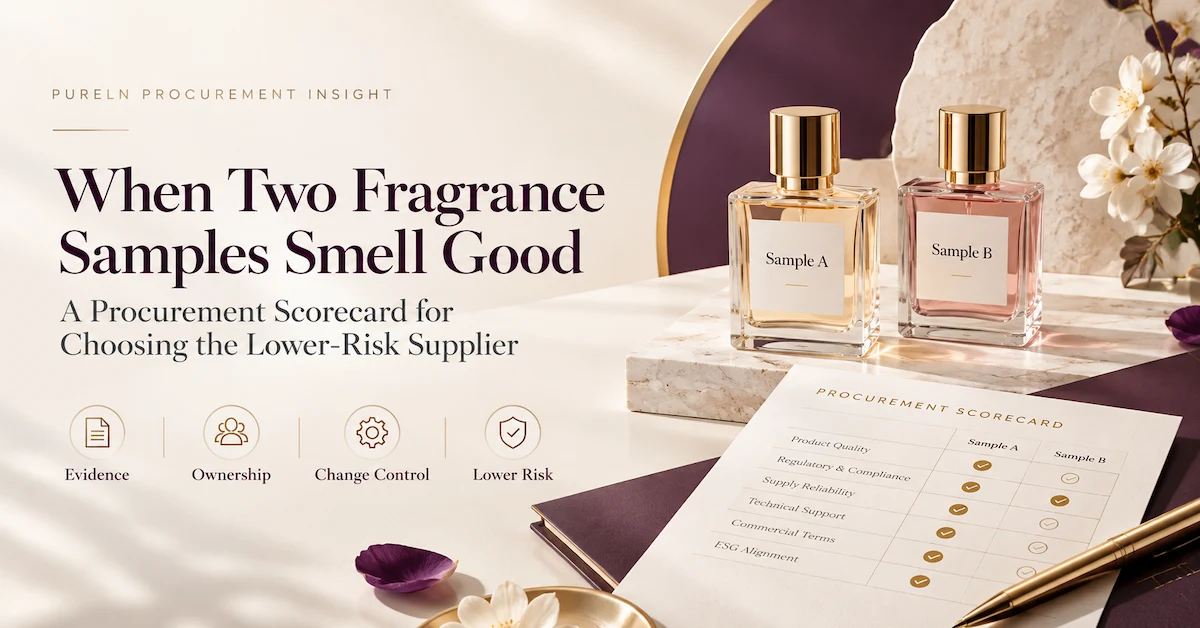
Use a scorecard so the best-smelling sample does not automatically win. Score the manufacturer on evidence and project fit, then score the sample on sensory and application performance. A supplier with a strong factory but a poor fit for your base may not be right for the project; a supplier with a pleasant sample but no traceability creates scale-up risk.
| Score area | High-confidence signal | Risk signal |
|---|---|---|
| Manufacturer identity | Clear site, entity, production owner and document issuer. | Unclear factory or documents issued by an unrelated entity. |
| R&D | Brief-led development with named technical ownership. | Only scent names and generic promises. |
| Materials | Formula-specific documentation and change notification. | One generic certificate for every product. |
| Blending and QC | Lot records, release checks, retained sample and corrective action. | No clear transfer from sample to bulk. |
| Commercial terms | MOQ, cost, pack and lead time stated by project route. | Headline price with hidden assumptions. |
| Communication | One commercial owner and accessible R&D/QC contacts. | Sales cannot answer technical or release questions. |
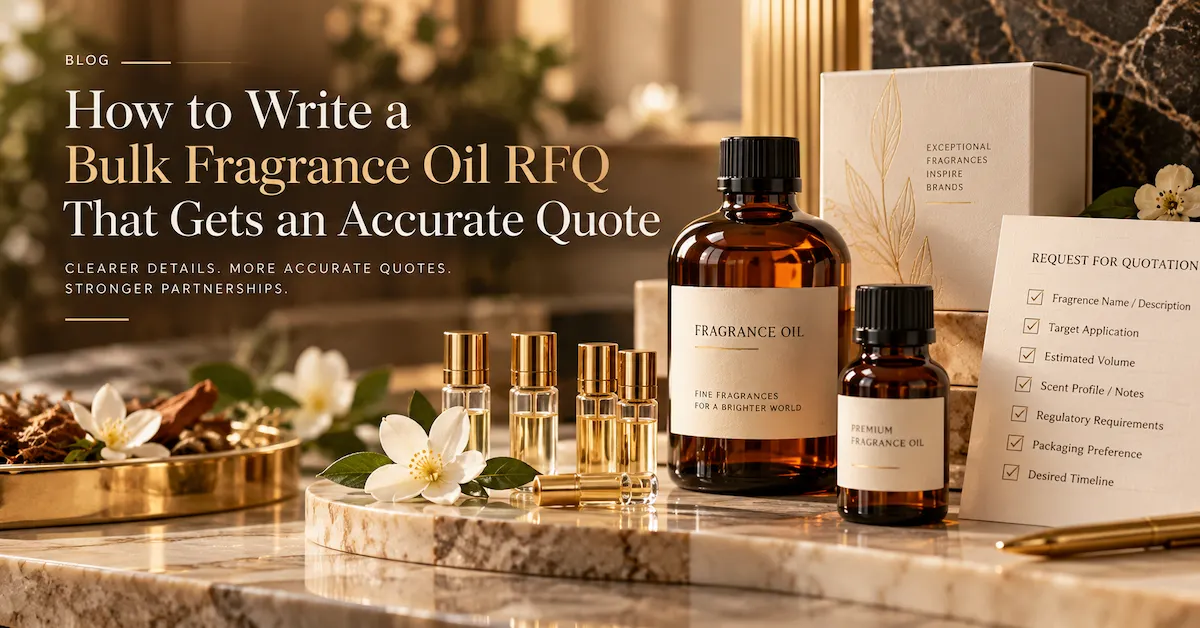
12. Prepare an RFQ that a manufacturer can answer
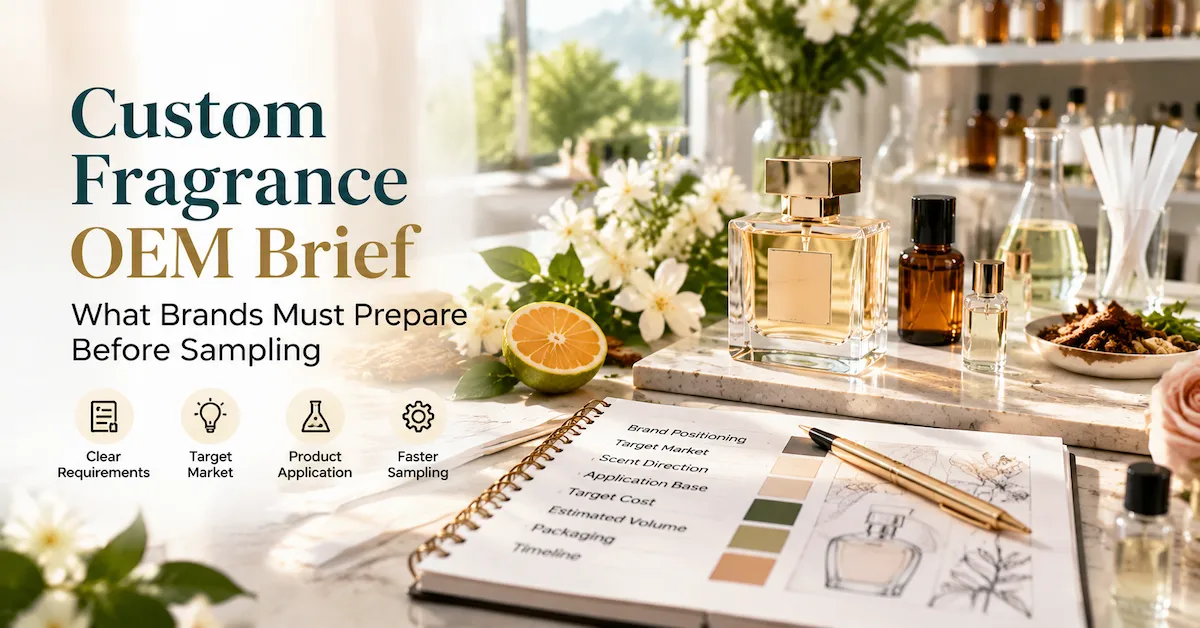
A good RFQ gives the supplier enough context to recommend the right route and gives your team a comparable response. Include the following fields instead of asking only for a catalog and price:
- Company and product: brand, product format, channel, customer and launch market.
- Fragrance direction: reference scent, desired notes, notes to avoid, intensity, dry-down and closeness target.
- Application base: base formula or representative sample, pH or solvent system, dosage, process and pack contact materials.
- Performance target: diffusion, retention, rinse-off, low residue, heat awareness, fabric deposition or other measurable requirement.
- Commercial frame: target cost, sample size, first order, annual forecast, MOQ basis, currency and Incoterm.
- Packaging: bulk container or finished pack, bottle, closure, label, carton, pallet and artwork responsibilities.
- Documents: SDS/MSDS, IFRA-related information, COA, allergen, INCI, specification and transport requirements.
- Timeline: first sample, feedback date, revision allowance, testing gate, purchase order and delivery target.
- Approval: evaluators, pass/fail criteria, retained sample, change control and complaint route.
Pureln's public contact page uses a structured brief with product application, target market, target price or annual volume, required sample size, formula or base system, project timeline and required documents. You can use the same fields when comparing suppliers, because they expose whether a proposed fragrance oil supplier is prepared to work with a real product rather than a vague scent request.
A practical example: from brief to bulk fragrance oil
Consider a home-fragrance brand launching a 100 ml reed diffuser in Europe. Its first request is “a clean hotel scent with strong diffusion.” A manufacturer cannot responsibly quote the project from that sentence alone. The usable brief would identify a reed diffuser format, carrier system, bottle and reed materials, target room perception, desired scent family, reference sample, target oil dosage, target cost per finished unit, first order quantity, annual forecast, packaging, document needs and launch date.
The manufacturer can then propose a sampling route: review the reference, create two or three directions, test them in the stated carrier and reed system, observe clarity, color, evaporation and residue, compare diffusion over an agreed period, and return sample codes with the requested documents. After approval, the same formula revision and pack assumptions move into a pilot or bulk batch. The buyer retains the approved reference and checks the first lot before release.
This example is a workflow illustration, not a claim about a specific customer project. It shows why manufacturer capability is evaluated through inputs, evidence and repeatability rather than through a scent name or a single sample bottle.
FAQ: fragrance oil manufacturer selection
What is the difference between a fragrance oil manufacturer and a fragrance oil supplier?
A manufacturer controls or manages the development, material selection, blending, quality release and production process for the oil. A supplier may manufacture, distribute, broker or combine several routes. Ask who owns the formula, where the bulk lot is made, who issues the documents and who handles a quality complaint.
What should I test before choosing a fragrance oil manufacturer?
Test the supplier's ability to understand your brief, work with your application base, provide formula-specific documents, explain blending and QC, quote MOQ and lead time by project route, protect confidential information and compare bulk lots with the approved sample. Test the fragrance in the finished product, not only as neat oil.
Can one fragrance oil formula work for several applications?
Sometimes a direction can be adapted across applications, but a formula should not be assumed to work unchanged in alcohol, water, surfactant, wax, carrier, fabric or an atomization system. Each application can change solubility, color, stability, diffusion, residue and sensory performance. Request application-specific testing before extending an approval.
How much MOQ should I expect for bulk fragrance oil?
There is no responsible universal number. MOQ can vary with stock versus custom formula, raw materials, batch size, packaging, annual volume and whether you buy oil or finished units. Ask the manufacturer to state the MOQ unit and route in writing, then compare suppliers on the same basis.
What documents should a fragrance oil manufacturer provide?
Depending on application and market, buyers may request SDS or MSDS, IFRA-related information, COA, allergen declaration, INCI or ingredient information, specification sheet and transport information. Documents must match the current formula and intended market. A sample-specific transport report or MSDS is not a blanket certificate for all formulas.
How can I reduce batch-to-batch fragrance variation?
Approve a coded sample and revision, retain a golden reference, define sensory and physical acceptance limits, request lot-level release information, compare the first bulk lot with the approved sample and require change notification before raw-material, formula, process or packaging changes. This creates a repeatable commercial standard without promising impossible absolute identity.
Conclusion
The right fragrance oil manufacturer is a production partner that can connect R&D, materials, blending, application testing, quality release and bulk supply. A factory location or attractive scent catalog is only the first filter. The stronger decision comes from evidence: a clear manufacturer identity, a brief-led R&D process, formula-specific material information, controlled blending, defined testing, batch traceability, realistic MOQ and lead time, suitable packaging and documents that match the application and market.
Pureln's public Guangzhou factory profile, R&D and QC information, application-led process, sample workflow and compliance resources provide a starting point for B2B evaluation. Use the commercial pages to describe your product, then request a project-specific quote and sample plan. When the supplier can explain how an approved fragrance becomes a repeatable bulk lot, you have a much stronger basis for choosing a long-term fragrance oil manufacturer.