Many B2B buyers send a message that says, “Please quote your best fragrance oil and send samples.” That request produces a catalogue response, not a procurement decision. The supplier may not know whether the oil will be used in a reed diffuser, detergent, shampoo, body mist, car diffuser, candle or commercial scenting system. It may not know the destination market, expected dosage, packaging contact or annual demand. Without those inputs, a price and sample are difficult to compare with another supplier's response.
This article focuses on one transaction problem: how to prepare and verify a fragrance oil supplier RFQ before ordering bulk fragrance oil. It is not a general manufacturer-selection article, a sample-approval testing protocol or an OEM brief about brand positioning. The practical output is an RFQ structure that purchasing, formulation, quality and regulatory teams can use to ask comparable questions and decide whether a supplier can support the intended product.
What a fragrance oil supplier must prove before you compare price
Price is the final line of an RFQ, not the first qualification. Before comparing numbers, establish whether the supplier is quoting the same product and the same responsibility boundary. A fragrance oil supplier may be a fragrance manufacturer, a compounder, a distributor, a private-label assembler or a trading company that coordinates a third-party factory. Each route can be valid, but the buyer must know who controls the formula, production release, documents and corrective action.
| Question | Why procurement needs it | Evidence to request |
|---|---|---|
| Who will manufacture and release the oil? | Responsibility cannot be assigned if the site and legal entity are unclear. | Legal entity, site address, technical owner and issuer of quality documents. |
| What exact application is being quoted? | The same scent can behave differently in different bases and delivery systems. | Application, base, dosage range, format and performance target. |
| What is included in the price? | Testing, filling, packaging and export documents can materially change landed cost. | Unit basis, inclusions, exclusions, Incoterm and payment assumptions. |
| What happens after the first order? | Replenishment is where an attractive sample becomes a supply relationship. | Retained reference, batch release method, change notification and reorder lead time. |
A high-quality response does not need to reveal proprietary formula percentages. It does need to identify the version being quoted, the information that supports safe and legal use, the assumptions behind the price and the controls that keep the first production lot connected to the approved sample.
Build the RFQ around the finished application
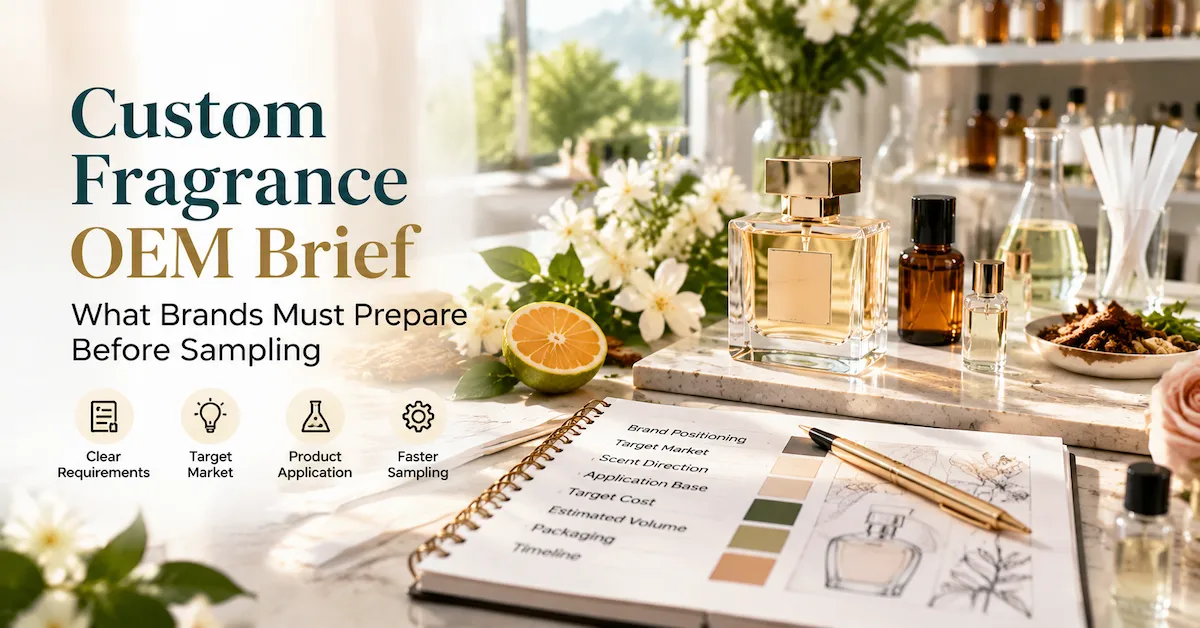
Start with the product that will contain the fragrance oil, not the scent family. “Fresh,” “luxury,” “long-lasting” and “premium” are useful creative direction, but they do not tell a supplier how the oil must perform. A complete RFQ gives the supplier enough context to select materials, propose a dosage, prepare representative samples and identify constraints before quoting.
| RFQ input | What the buyer should write | What the supplier can then confirm |
|---|---|---|
| Finished format | Reed diffuser, candle, room spray, shampoo, detergent, body mist, car diffuser or another defined format. | Relevant volatility, carrier, heat, solvent, surfactant or packaging questions. |
| Base and process | Base description, pH or solvent context, mixing sequence and whether the product is rinse-off, leave-on or ambient. | Sample preparation route, compatibility questions and suitable performance language. |
| Target market | Country or region, customer type, label constraints and intended sales channel. | Document scope, restricted-material questions and market-specific review needs. |
| Performance objective | Long-lasting, high diffusion, low residue, malodor masking, soap stable, shampoo stable or another measurable priority. | Which application evidence and evaluation conditions are relevant. |
| Commercial target | Target cost basis, annual volume, first order and launch date. | MOQ, price breaks, production route and lead-time assumptions. |
Application and delivery system are not the same field
Write both fields. “Home fragrance” is an application family; “reed diffuser with a low-viscosity carrier and clear liquid requirement” describes a buying condition. “Personal care” is an application family; “shampoo at a defined fragrance dosage with color and after-feel limits” gives the supplier a development boundary. Pureln's applications page groups formats such as reed diffuser, room spray, candle, aroma diffuser, air freshener, laundry detergent, fabric softener, shampoo, soap and private-label perfume. Use that structure to name the exact product format in the RFQ rather than asking for an oil that is supposedly suitable for everything.
State the intended market before requesting documents
Documents are not interchangeable across every formula and market. A supplier needs to know whether the oil will be used in a household product, a personal-care product, a fine-fragrance product, an institutional product or an automotive product, and where the finished goods will be sold. The same fragrance direction may require different use-level review, label information, allergen review, transport documentation or customer specification support depending on the route.
Use the Pureln applications overview to choose an application family, then state the product format, market and performance requirement in your RFQ. This internal link supports commercial intent without turning the article into a general application guide.
Have the application and performance target ready?
Match Your ApplicationRequest samples that can be compared with the quotation
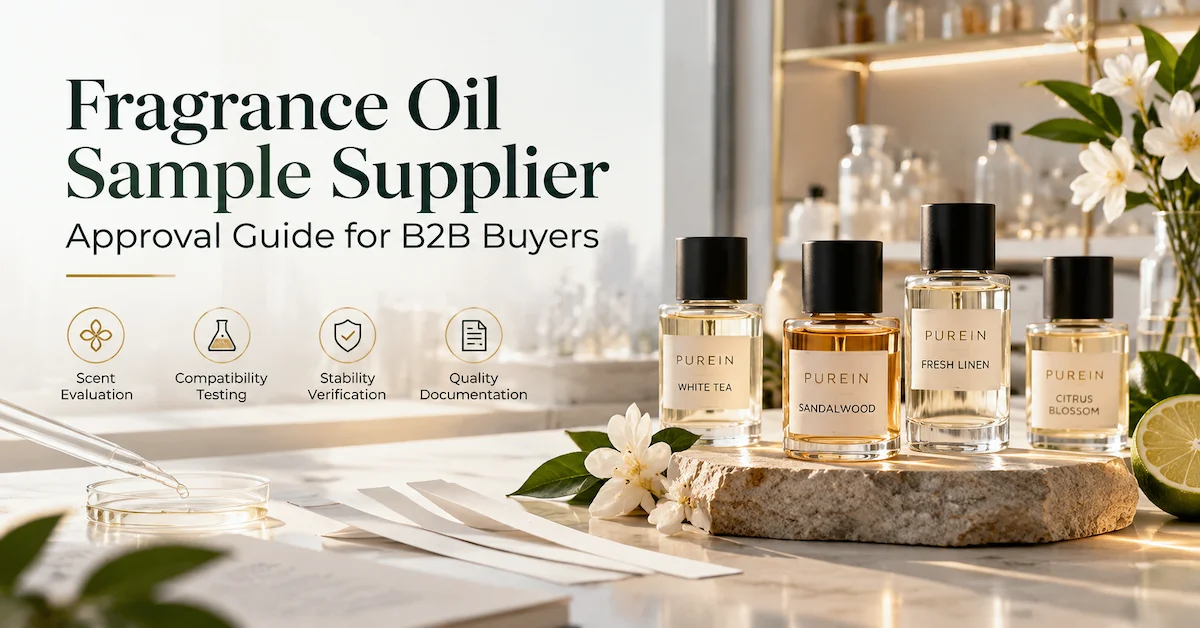
A sample request should test whether the supplier understood the RFQ, not simply whether it can send attractive blotters. Ask every shortlisted fragrance oil supplier for the same sample structure. A useful set normally includes the proposed reference, the supplier's closest alternative or cost-down option where relevant, and a clear sample code that appears on the quotation and later documents.
| Sample item | Minimum identification | Why it matters to procurement |
|---|---|---|
| Supplier reference | Code, revision, preparation date and storage instruction. | Prevents a later quotation or batch from using an unapproved version. |
| Application note | Intended base, suggested dosage or concentration and key limitation. | Shows whether the sample represents the product you will buy. |
| Commercial link | Sample code linked to price basis, MOQ and lead-time assumption. | Stops a low-cost sample from being replaced by a different bulk route. |
| Document route | List of files available for the formula and target market. | Makes regulatory and customer review part of the selection, not a late surprise. |
Pureln's public sample request form asks buyers to share fragrance type, application base, solubility, target price and estimated annual volume. Those fields are commercially useful because they connect the sample to the eventual order. Add the reference scent, target market, package contact and document requirements when the project requires them. You can start with the fragrance sample request form and keep the same project code in every follow-up.
Verify the product specification without demanding a proprietary formula
A fragrance oil supplier can protect its formula and still provide a useful specification. Ask for the product identity and the characteristics that matter to your application. The exact values should be agreed for the specific formula; do not copy generic ranges from another product into your purchase specification.
| Specification area | Buyer question | Release evidence |
|---|---|---|
| Identity | What code, revision and product name identify the oil? | Approved code on sample, quotation, batch label and documents. |
| Physical profile | Which appearance, color, density, solubility or viscosity characteristics affect use? | Agreed specification or COA fields with method and acceptance range. |
| Sensory profile | What reference, evaluation condition and tolerance define an acceptable odor? | Retained reference, sensory method and documented disposition for deviations. |
| Material scope | Which carrier, natural material or restricted component is critical to the project? | Formula-specific SDS or material information and change-notification route. |
| Storage and shelf context | What container, temperature, light and storage period apply before use? | Handling instruction and project-specific stability or retention evidence where required. |
One public sample-specific MSDS reviewed in the Pureln evidence set lists components such as dipropylene glycol at 10-50%, phenylethyl alcohol at 2-10%, vanillin at 1-2% and bergamot oil at 5-20%. This is an example of the type of composition information that may appear in a document for one tested sample; it is not a universal formula, specification or approval for every Pureln fragrance oil. The correct RFQ question is whether the supplier can provide current information for the formula being quoted and explain what remains confidential.
Make MOQ, price and lead time comparable
“Low MOQ” and “fast delivery” are incomplete commercial claims until the unit and trigger are written down. A fragrance oil supplier may quote a small MOQ for a stock item, while a custom compound, special package or export document route has a different minimum. The lead-time clock may start at sample approval, payment, purchase order, packaging release or raw-material confirmation. Put the unit behind every number.
| Commercial field | Write this in the RFQ | Common ambiguity to remove |
|---|---|---|
| MOQ | Kilograms of oil, finished units, component quantity or batch size. | A “100 kg MOQ” that excludes packaging or applies only to one scent. |
| Price | Price per kg or unit, currency, volume tier, Incoterm and included services. | A sample price compared with a bulk price that includes a different service route. |
| Lead time | Calendar days and the event that starts the clock. | “Two weeks” without stating whether packaging or documents are included. |
| Replenishment | Repeat MOQ, forecast requirement, retained material and reorder lead time. | Assuming the first-order timeline will automatically apply to repeat orders. |
| Packaging | Bulk drum, bottle, filling, label, carton, pallet and transport responsibility. | Comparing oil-only price with a filled private-label quotation. |
Pureln does not publish one universal MOQ or lead time for every fragrance oil formula and project route. That is the correct boundary for a project-based supplier. Request a quote tied to application, target market, annual volume, first order, sample size, packaging route and required documents. Treat an unspecified commercial number as an open question, not a confirmed capability.
Match every document to the formula, application and market
Document quantity is not document quality. A fragrance oil supplier can send a large file pack that still does not cover the formula or market you are buying for. Ask for the file name, revision, issue date, issuer, application category, destination market and limitation. Keep the document request inside the RFQ so the supplier can identify missing information before you approve a sample.
| Document | What it can support | What the buyer must still confirm |
|---|---|---|
| SDS or MSDS | Hazard, handling, storage and transport context for the named material or mixture. | Whether the revision matches the quoted formula and destination requirements. |
| IFRA-related information | Use-level review for the defined fragrance category and formula. | Category, formula scope, latest applicable amendment and local legal requirements. |
| Allergen or ingredient information | Customer, label or market review where required. | Thresholds, market format and whether the information is current for the formula. |
| COA or specification | Lot release against agreed physical or sensory characteristics. | Test method, acceptance range and link to the approved reference. |
| Transport report | Classification for the tested sample, quantity, packaging and transport mode. | Whether the report applies to the exact shipment and not to every formula. |
IFRA's public guidance explains that its Standards are a voluntary product-stewardship program and that IFRA itself does not issue certificates. It also distinguishes fragrance mixtures from finished consumer products and notes that national or local regulations still apply. In practical procurement terms, ask a supplier for formula- and category-specific conformity information, then have the responsible party review the destination market. Do not turn a generic “IFRA certificate available” statement into a blanket approval.
Pureln's public process page lists practical B2B document support such as SDS, IFRA, COA, allergen declaration, INCI and specifications when required. Link that promise to the RFQ: name the document, formula code, market and required date. You can also use the SDS request route when a project needs a document review separate from the sample request.
Need to confirm MOQ, lead time or document scope?
Discuss MOQ and DocumentsCheck the production route behind the sample
A sample proves that a supplier can prepare a sample. It does not automatically prove that the same supplier can blend, release, pack and replenish the commercial volume. Ask how the project moves from development to production and which team owns each handoff.
| Handoff | Question for the fragrance oil supplier | Evidence to retain |
|---|---|---|
| Sample to formula | Which sample code and revision will become the commercial formula? | Approved reference and signed or dated revision record. |
| Formula to batch | Which steps, materials or conditions are critical during blending? | Process summary, batch code and material-lot linkage. |
| Batch to release | Who checks the lot and what happens if it does not match? | COA or release record, deviation route and disposition owner. |
| Release to shipment | Who owns packaging, labels, export files and carrier handoff? | Responsibility matrix, packing confirmation and shipping documents. |
| Shipment to reorder | How is the same formula protected for replenishment? | Retained sample, change notice, reorder code and forecast assumption. |
Pureln states that its R&D and QC teams support fragrance oil blending, application development and finished-goods review. Its public figures identify 15 R&D engineers and eight QC inspectors. For a real RFQ, ask which person or team owns your formula, which site will produce it and what record will be supplied with the first commercial lot. This turns a capability statement into a project-level answer.
ISO 9001:2026 describes a quality-management framework built around customer requirements, controlled operations, documented information, performance evaluation and continual improvement. The standard does not prescribe one factory's process and certification should never be assumed. For supplier qualification, use the principle behind the standard: ask for evidence that the process is defined, responsibilities are clear, variation is reviewed and corrective action is recorded.
Compare RFQ responses with a decision matrix
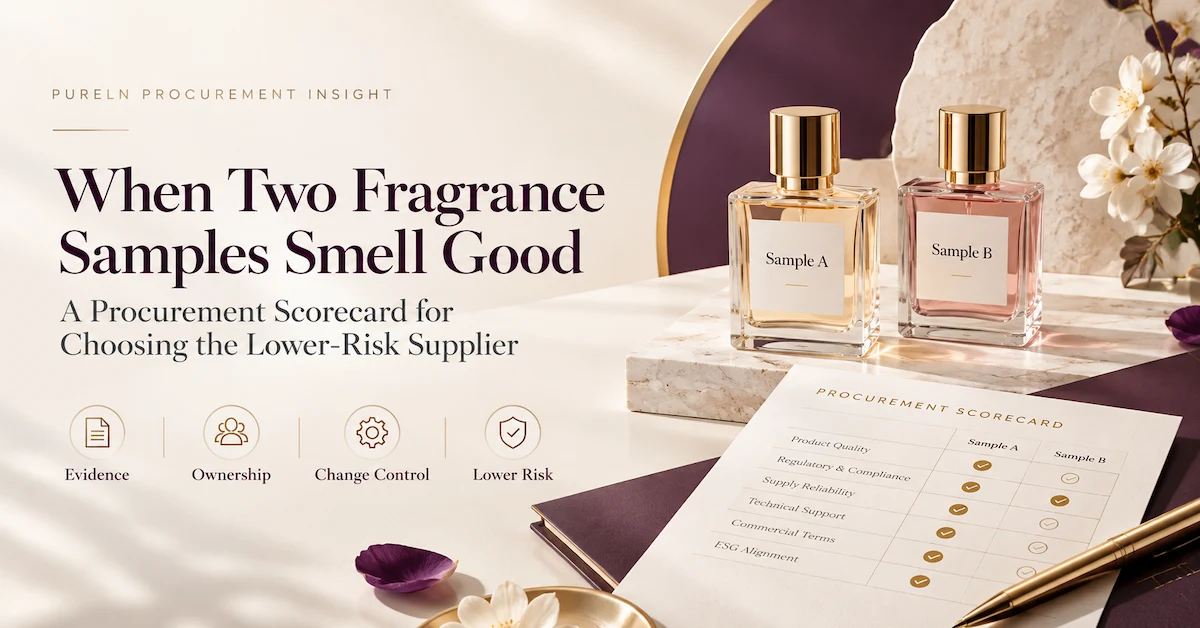
Do not compare suppliers from separate email threads. Put every response into one matrix and mark each field as confirmed, conditional or not evidenced. A field is confirmed only when the supplier states the scope and provides an answer that can be attached to the project record.
| Decision field | Confirmed | Conditional | Not evidenced |
|---|---|---|---|
| Application fit | Supplier names the base, format, dosage context and performance target. | Supplier needs a base sample or more process detail. | Supplier offers a catalogue scent with no application discussion. |
| Sample identity | Code and revision appear on sample, quote and follow-up. | Code exists but revision or storage information is open. | Unlabeled or changing samples. |
| MOQ and lead time | Unit, trigger, volume tiers and exclusions are written. | Supplier is waiting for packaging, volume or market details. | Only “low MOQ” or “fast delivery” is stated. |
| Documents | Formula, category, market and issue date are clear. | Document can be prepared after formula or market confirmation. | Generic certificate language with no scope. |
| Change control | Material, formula and packaging changes have notification and approval rules. | Supplier has a process but has not supplied the project owner or example. | Supplier treats every replacement as an internal decision. |
| Commercial award | All release-critical fields are confirmed. | Order is blocked until named open items close. | Do not award on price alone. |
This matrix is deliberately different from a generic supplier scorecard. It does not pretend to calculate a universal quality number. It shows whether the supplier answered the fields that make this RFQ purchasable. The procurement team can add a price comparison after the scope is normalized, but it should not hide missing application, document or replenishment evidence.
Red flags that should stop a bulk award
Some responses are not merely incomplete; they indicate that the supplier and buyer are discussing different products. Stop the award or return the RFQ for clarification when you see any of the following:
- The supplier cannot state whether it is the manufacturer, a distributor or a coordinator for another factory.
- The sample has no code, revision or preparation date, and the quotation uses a different name.
- The supplier promises one oil for unrelated bases without asking about dosage, process or packaging.
- MOQ and lead time are expressed only as “small” or “fast” with no unit or trigger.
- A generic SDS, IFRA statement or certificate is presented as proof for every formula and market.
- Substitution is described as an internal matter with no customer notification or re-approval.
- The supplier cannot identify who releases the batch or who owns a deviation before shipment.
- The lowest price excludes the testing, filling, packaging or document work that other suppliers included.
A red flag is not always a rejection. It is a reason to change the response from “quote accepted” to “clarification required.” Record the question and the supplier's answer. The goal is a traceable purchase decision, not a performative checklist.
Move from RFQ to order without losing the evidence
Once the supplier is commercially preferred, keep the RFQ as part of the order file. The handoff should contain the same information that made the supplier's response comparable.
| Stage | Buyer action | Supplier output to retain |
|---|---|---|
| RFQ issue | Send one brief revision and response deadline. | Acknowledgement, questions and assumptions. |
| Sample review | Record code, application context and decision. | Sample code, revision, suggested use and document route. |
| Commercial approval | Confirm MOQ unit, price basis, packaging and lead-time trigger. | Final quotation with inclusions, exclusions and validity. |
| Purchase order | Attach approved reference and required document list. | Order confirmation, planned batch and production schedule. |
| First release | Compare received lot with the approved record. | Batch documents, retained reference and deviation response if needed. |
Pureln's public application-led development process describes the connection between perfumery, application performance and B2B documentation. The RFQ should preserve that connection by carrying the application, performance label, sample code and document scope into the order file.
FAQ: fragrance oil supplier RFQs
What should I send a fragrance oil supplier first?
Send the finished product format, application base, target market, reference scent or odor direction, dosage or concentration context, target cost, first-order and annual volume, package route, required documents and target date. A supplier can then decide whether it needs a base sample, a technical clarification or a different development route.
Can a fragrance oil supplier quote without knowing the final application?
It can quote a catalogue or indicative sample, but the number may not represent the formula, dosage, documentation or testing route needed for the finished product. For a transaction-ready quote, provide the application and market. Otherwise mark the quote as preliminary and do not compare it directly with a project-specific response.
How can I compare MOQ from different suppliers?
Write the unit beside every MOQ: kilograms of fragrance oil, finished units, packaging components or batch size. Also ask whether the MOQ applies to one formula, a scent family, a packaging configuration or a mixed order. Compare the same unit and service scope before using MOQ as a buying criterion.
Does an IFRA document prove that an oil is suitable for my product?
No. IFRA-related information supports a defined fragrance category and formula scope; it does not replace application compatibility, local legal review, finished-product testing or package evaluation. Ask the supplier for the relevant formula information and have the responsible regulatory or quality team confirm the destination-market requirements.
What is the best CTA after reading this guide?
Request samples with the application base, target market, solubility, target price and estimated annual volume included. A sample request with those fields gives a fragrance oil supplier enough context to return a more useful first response than a generic catalogue request.
Conclusion
A fragrance oil supplier should earn an RFQ award by answering the product you will actually buy, not by sending the largest scent catalogue or the lowest unqualified price. Define the application, market, sample reference, specification, MOQ, documents, packaging and lead-time trigger in one request. Then compare each response by scope, evidence and responsibility.
Pureln's public manufacturing and application information provides a useful starting point: a Guangzhou production base, oil blending, application-led development, R&D and QC support, OEM/private-label capability and document-request routes. The final decision remains project-specific. Confirm the formula, sample code, specification, MOQ, document set and delivery route before you issue a bulk order.
Ready to turn your RFQ into comparable fragrance samples?
Request Fragrance Samples