Why an Accurate Fragrance Oil Quote Starts With the RFQ
Direct answer: what should a bulk fragrance oil RFQ include?
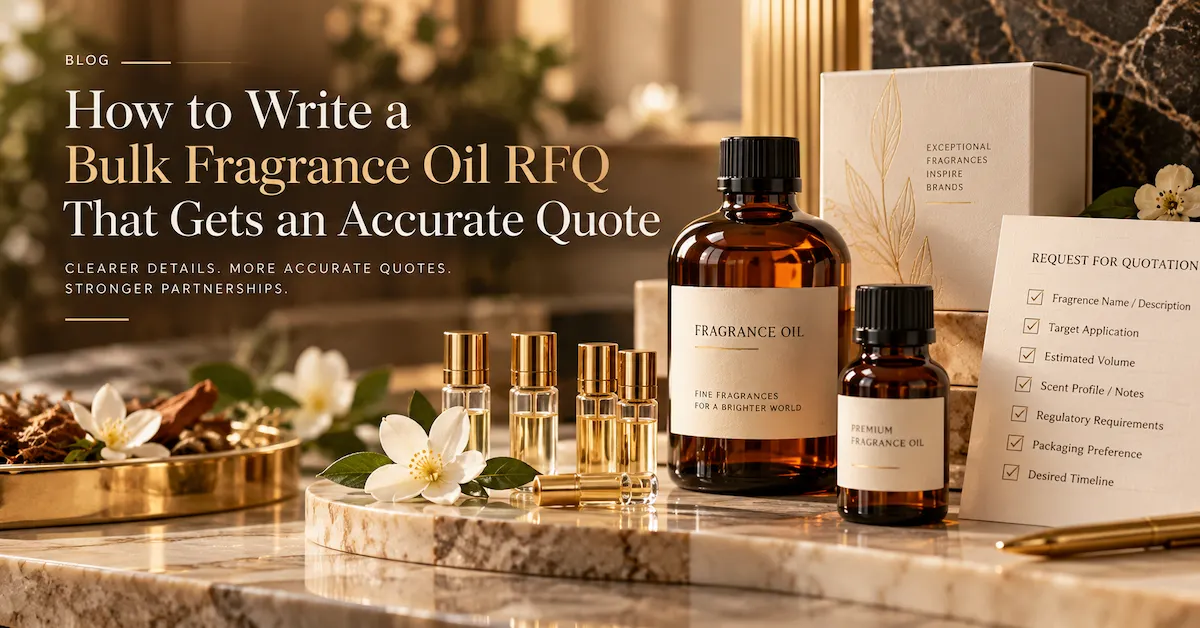
At minimum, give the supplier seven inputs: application, formulation base, target market, target cost, order volume, required documents and project timeline. Add your scent direction, reference sample, intended dosage, packaging and development scope when those details are available.
Pureln's current sample request process already asks buyers for fragrance type, application base, solubility, target price, anticipated annual volume and required documents. Those fields provide a practical starting point for an RFQ because they connect scent selection to the finished product and commercial plan.
Have a Project Brief Ready?
Send the application, product base, target price and expected volume before requesting fragrance samples.
Submit Your Fragrance Brief →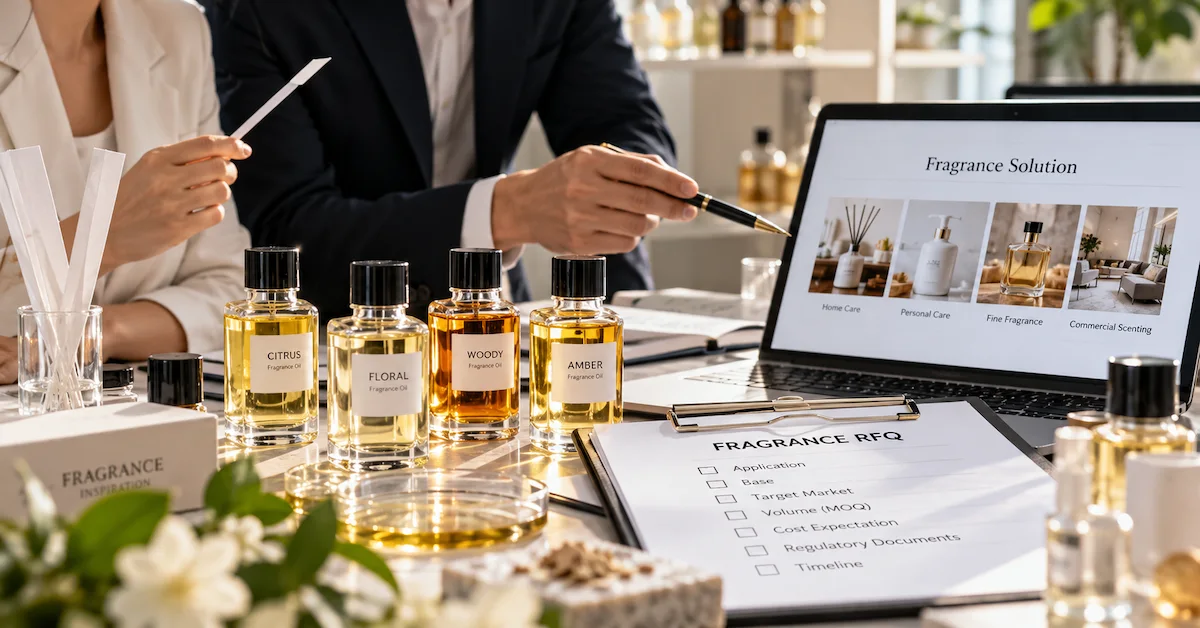
1. Start the RFQ With the Exact Application
The first field should describe the finished product. “Fragrance oil” identifies what you want to buy, but it does not explain how that material will be used.
This matters because fragrance development is application-specific. Pureln organizes its fragrance applications around real product formats including fine fragrance, personal care, laundry and fabric care, home care, home fragrance, automotive air care and other B2B uses.
Name the Finished Product, Not Only the Scent
Instead of writing:
Need: Fresh floral fragrance oil.
write something closer to:
Application: Fragrance oil for a liquid fabric softener sold through retail channels in the Middle East. We want a clean floral direction with a soft musky dry-down and need samples suitable for evaluation in our existing formulation.
The second version immediately gives the supplier more context for scent direction, application evaluation and commercial discussion.
Typical Application Information to Include
| Application | Useful RFQ Information |
|---|---|
| Fine fragrance | EDP, EDT, perfume oil or body mist; intended concentration; positioning; reference direction. |
| Personal care | Shampoo, body wash, soap, lotion or other format; rinse-off or leave-on use; base information. |
| Laundry care | Detergent, fabric softener, fabric spray or other use; formulation type; intended freshness profile. |
| Home fragrance | Reed diffuser, candle, room spray, wax melt or diffuser system; base or wax information. |
| Air care | Aerosol, liquid, electric, plug-in or commercial scenting application. |
| Automotive | Vent clip, hanging format, car diffuser, gel or other delivery system. |
The RFQ does not need to become a formulation dossier. It needs enough application detail to stop the supplier from guessing what “suitable fragrance oil” means.
State the Performance Question You Need Answered
Replace vague requests such as “must be high quality” or “must last a long time” with a practical evaluation question.
For example:
- We need to evaluate fragrance stability in our shampoo base.
- We want to compare diffusion behavior in our reed diffuser system.
- We need to assess the scent after the laundry product has been used.
- We need a fine-fragrance direction suitable for our target positioning and concentration.
- We are evaluating fragrance options for a car-air format exposed to warm interior conditions.
Pureln describes its development approach as application-led, considering product base, dosage, diffusion, longevity, residue control and malodor coverage instead of selecting by scent family alone. Buyers can use the same logic when preparing an RFQ through the How We Do It page.
2. Describe the Formulation Base Before Asking for a Final Price
The formulation base is the second critical RFQ field because fragrance behavior can change after it enters the finished product. A scent evaluated neat is not the same as a fragrance evaluated in a surfactant system, alcohol base, wax or diffuser solvent.
What Base Information Should You Share?
Provide the information your technical team can disclose without exposing unnecessary proprietary details:
- Base type: water, alcohol, oil, wax, surfactant system or other relevant format.
- Solubility requirement.
- Known ingredients that may create a harsh or challenging environment for the fragrance.
- Relevant pH information where appropriate.
- Processing temperature or manufacturing conditions where they may affect evaluation.
- Planned fragrance dosage or an approximate evaluation range if already established.
- Appearance requirements such as clarity or acceptable color impact.
- Known compatibility problems from previous fragrance trials.
Pureln's own sample request form specifically asks customers to identify solubility and to list hostile or harsh ingredients in the final formulation that could affect fragrance stability. That is a useful clue for buyers: formulation context belongs in the RFQ, not only in later troubleshooting.
Different Bases Create Different RFQ Questions
Personal Care Base
For shampoo, conditioner, body wash, soap or lotion, describe whether the product is rinse-off or leave-on and provide relevant information about the base. Pureln's personal care fragrance page notes that these bases can affect fragrance bloom, stability, color, viscosity and after-feel.
Laundry or Home-Care Base
For detergent, fabric softener or household cleaning products, identify the actual product type and relevant formulation conditions. Pureln's home care and fabric care range includes laundry detergent, fabric softener, fabric spray and multiple cleaning applications.
Home Fragrance Base
For a reed diffuser, candle or room spray, tell the supplier which delivery system you are developing. The home fragrance section distinguishes between diffuser, candle, room spray and related formats because diffusion behavior and compatibility questions differ.
Do Not Hide an Important Technical Constraint Until After Quotation
If your base has already caused cloudiness, separation, discoloration, fragrance loss or another issue with previous samples, state the problem. That information can influence which fragrance direction should be evaluated and whether additional application work is required.
A technically difficult base should not be quoted as though the supplier were simply shipping an off-the-shelf scent with no evaluation requirement.
3. Define the Target Market and Commercial Positioning
The target market tells a bulk fragrance oil supplier where the finished product will compete and what type of scent direction, documentation and commercial framework may be relevant.
Do not reduce this field to a country name. Give enough context for the supplier to understand the positioning.
Include the Destination Market
State the country or region where the finished product is intended to be sold. If one fragrance will support launches in several markets, list them.
This does not transfer regulatory responsibility to the fragrance supplier. Your own technical or regulatory team must determine the requirements applicable to the finished product. However, the supplier needs to know which document requests and product questions may need to be addressed during development.
Add Brand and Price Positioning
Useful RFQ information includes:
- Premium, mid-market or value positioning.
- Retail, e-commerce, hospitality, professional-use or distributor channel.
- Target consumer.
- Expected scent character.
- Competitor or benchmark products.
- Regional scent preferences already identified by your team.
Pureln's fragrance portfolio states that B2B briefs are interpreted around application, target market, scent direction, performance needs and budget. Those are useful fields for any serious purchasing RFQ.
Use a Reference Without Turning It Into a Vague Copy Request
If you have a benchmark, explain what you like about it. Is it the opening freshness, floral character, dry-down, perceived cleanliness, intensity, premium positioning or overall mood?
For example:
Reference direction: We want a clean citrus-floral profile with a soft musky base. The benchmark communicates the general consumer direction. We are open to a distinct fragrance solution rather than an exact duplication.
That gives a fragrance formulation service a usable creative direction while leaving room for development around your own product requirements.
4. Give the Supplier a Realistic Target Cost
Price becomes more useful when it is connected to a defined scope. A target cost without application, volume or development requirements can push the discussion toward a number that later proves irrelevant.
State What the Target Price Means
If you have an internal cost target, include:
- Target price or acceptable range.
- Currency.
- Quantity on which the target is based.
- Whether packaging is included.
- Whether the request is material-only or includes a custom development scope.
- Delivery basis or destination when known.
If you do not yet have a target, say that you want the supplier to quote against specific volume tiers. That is more useful than inventing a budget simply to fill in the RFQ.
Do Not Compare Price Per Kilogram Before Comparing Scope
Two quotations can have the same unit of measure and still represent different offers.
Supplier A may quote an existing fragrance already in its portfolio. Supplier B may quote a project involving fragrance modification, several sample revisions and application support. Supplier C may be pricing a different quantity or packaging basis.
Before ranking the offers, ask each supplier to state:
- Fragrance or product code being quoted.
- Quantity basis.
- Packaging basis.
- Sample scope.
- Development scope.
- Document support included.
- Commercial terms and quotation validity.
Use the Budget to Guide Alternatives
If the preferred scent direction and target cost appear difficult to reconcile, ask the supplier whether another fragrance direction or project route can better fit the commercial target.
That creates a useful commercial conversation:
Option 1: Prioritize the preferred fragrance direction.
Option 2: Recommend an alternative that better fits the target price while retaining mandatory application requirements.
The buyer can then evaluate the alternatives instead of forcing an unsuitable fragrance into an arbitrary cost target.
5. Separate Sample Quantity, Initial Order and Annual Volume
Volume has a direct effect on the commercial conversation, yet many RFQs contain only one number. That number can be misleading because buyers usually move through more than one purchasing stage.
Use Three Different Volume Fields
| Volume | Why the Supplier Needs It |
|---|---|
| Sample quantity | Defines the material required for scent and application evaluation. |
| Initial commercial order | Provides the immediate quantity basis for a commercial quotation. |
| Estimated annual volume | Gives context for expected repeat business and future purchasing scale. |
Pureln's sample form specifically asks for anticipated annual volume, which is useful because a fragrance oil sample supplier needs to understand whether the inquiry is an isolated trial or the beginning of a larger B2B program.
How Should You Ask About Fragrance Oil MOQ?
Do not ask only:
“What is your fragrance oil MOQ?”
Ask:
Please confirm the applicable fragrance oil MOQ for this specific fragrance, customization scope and packaging requirement. Our planned first order is [quantity], with estimated annual demand of [volume].
This gives the supplier enough context to answer the commercial question accurately.
A fixed public MOQ should not be assumed if the supplier has not stated one for the exact project. Existing fragrances, customized development, packaging arrangements and order conditions may not follow identical minimums.
Ask for Quantity Tiers When Your Demand Is Still Developing
If your sales forecast is uncertain, request quotations for clearly defined volume scenarios where the supplier can provide them. This may help a brand understand the difference between its first commercial order and future repeat-order economics.
Be transparent if annual demand is an estimate. A realistic forecast is more useful than an exaggerated number provided only to obtain a lower indicative quotation.
6. Put Regulatory and Technical Documents in the RFQ
Fragrance oil regulatory documents should be discussed before commercial approval, not added as an afterthought when goods are already being prepared.
The document package depends on the product, fragrance, application and destination market. Buyers should identify what their project requires and ask the supplier to confirm availability for the specific fragrance.
Common Documents to Discuss
| Document | RFQ Question |
|---|---|
| SDS | Can a current SDS be provided for the quoted fragrance? |
| COA | Can relevant batch quality documentation be supplied? |
| IFRA-related document | What documentation is available for the intended application? |
| Allergen information | Is the required allergen information available for this fragrance? |
| Specification | Which product characteristics can be documented for purchasing control? |
Pureln states that its B2B quality and compliance follow-up can include SDS, IFRA, COA, allergen declaration, INCI and specifications when required. Buyers can submit a product-specific request through the SDS and regulatory document form.
State When Each Document Is Needed
Your RFQ can distinguish between:
- Documents required before sample approval.
- Documents required before the purchase order.
- Documents required before shipment.
- Documents required for internal supplier qualification.
This prevents a common situation in which a technically acceptable fragrance reaches the end of development before the buyer discovers that an essential document is still missing.
Need Documents for Your RFQ Review?
Identify the fragrance, product number and required document package before commercial approval.
Request Technical Documents →7. Give the Supplier a Project Timeline, Not Just “Urgent”
Timeline is the seventh essential field because a quotation is not useful if it assumes a schedule that does not match the development process.
A custom fragrance project may need brief interpretation, sample preparation, buyer evaluation, revisions, document review and final commercial approval before production. An existing fragrance reference may follow a different path.
Break the Timeline Into Milestones
| Milestone | What to State |
|---|---|
| Quotation | When you need the initial commercial response. |
| Sample | When samples need to be available for evaluation. |
| Testing | How much time your team expects to need for application checks. |
| Approval | Target date for confirming the selected fragrance. |
| AFTER | Expected purchase-order timing. |
| Delivery | Required destination and requested delivery window. |
Ask What the Supplier's Timing Depends On
Instead of demanding a fixed lead time before the scope is known, ask the supplier to identify the dependencies behind its estimate.
Typical dependencies may include:
- Existing fragrance versus custom development.
- Number of sample revisions.
- Application evaluation.
- Buyer feedback speed.
- Document requirements.
- Packaging.
- Order quantity.
- Production scheduling.
- Shipment preparation.
This makes the timeline more useful for procurement because the buyer can see which dates are controlled by the supplier, which depend on internal approval and which remain provisional.
8. Tell the Supplier Whether You Need Samples, Matching or Formulation Support
A quotation can change significantly depending on whether the buyer wants an existing fragrance, sample matching, modification support or a broader fragrance formulation service.
Existing Fragrance Selection
If you have selected a direction from the supplier's portfolio, identify the fragrance or product code and ask for:
- Sample availability.
- Application suitability discussion.
- Applicable fragrance oil MOQ.
- Pricing at the required volume.
- Relevant regulatory and technical documents.
Pureln's Our Fragrances page organizes directions around finished-product applications and B2B brief development, which can help buyers identify the appropriate category before submitting a sample request.
Reference Sample or Scent Direction
If you have a benchmark, explain whether you want the supplier to:
- Recommend a fragrance in a similar olfactive direction.
- Develop a distinct fragrance inspired by selected characteristics.
- Modify an existing sample after evaluation.
- Work toward specific sensory and application requirements.
This makes the expected service clearer than simply sending a benchmark and asking for “the same smell.”
Fragrance Formulation Service
If the project needs development rather than catalog selection, say so in the RFQ.
A useful brief should include:
- Creative direction.
- Finished-product application.
- Base information.
- Target market.
- Reference materials.
- Mandatory performance or document requirements.
- Budget.
- Expected commercial volume.
- Timeline.
Ask what stages the fragrance formulation service covers and what the supplier still needs from your R&D team before samples can be prepared.
Evaluate the Fragrance Oil Sample Supplier Before Bulk Approval
A fragrance oil sample supplier should provide samples that can be identified and compared. Record the product code or sample reference, date received, intended application and revision status when multiple versions are evaluated.
The purpose is simple: when the buyer eventually places a bulk order, both parties should understand which fragrance was actually approved.
9. How to Handle “Fragrance Oil Sourcing China” in the RFQ
For buyers researching fragrance oil sourcing China, the most useful question is not “How do I import fragrance from China?” That is a separate logistics and import topic.
At the RFQ stage, the better question is:
The answer is the same seven-field framework:
- Application.
- Formulation base.
- Target market.
- Target cost.
- Volume and MOQ requirements.
- Technical and regulatory documents.
- Timeline.
Then add the commercial details required for your sourcing process, such as packaging, delivery destination, quotation currency and relevant purchasing terms.
Do Not Use Country of Origin as a Substitute for Supplier Qualification
Whether the supplier is in China or another manufacturing market, the RFQ should create evidence you can compare. Evaluate whether the supplier understands the application, responds to the technical brief, provides suitable samples, explains its quotation assumptions and can support the required documents.
A sourcing request such as “fragrance oil manufacturer China, please send catalog and best price” creates little basis for meaningful comparison.
A structured brief creates a procurement record.
10. Compare Supplier Quotes on the Same Basis
Once quotations arrive, check whether the suppliers actually quoted the same project before comparing unit prices.
| Comparison Item | Supplier A | Supplier B | Supplier C |
|---|---|---|---|
| Fragrance / product reference | Confirm | Confirm | Confirm |
| Application | Confirm | Confirm | Confirm |
| Sample / development scope | Confirm | Confirm | Confirm |
| Fragrance oil MOQ | Confirm | Confirm | Confirm |
| Quoted volume | Confirm | Confirm | Confirm |
| Unit price / currency | Confirm | Confirm | Confirm |
| Packaging | Confirm | Confirm | Confirm |
| Documents | Confirm | Confirm | Confirm |
| Timeline | Confirm | Confirm | Confirm |
| Delivery basis | Confirm | Confirm | Confirm |
Three Questions to Ask Before Choosing the Lowest Quote
- Did every supplier quote the same fragrance-development scope?
- Did every supplier use the same quantity and packaging assumptions?
- Are the required samples, technical documents and commercial conditions comparable?
If the answer to any of those questions is no, normalize the quotation first.
11. Copy-Ready Bulk Fragrance Oil RFQ Template
The following template can be adapted for perfume, home fragrance, personal care, laundry, air care or other B2B fragrance projects.
Bulk Fragrance Oil RFQ
Company Information
Company: [Company name]
Contact: [Name / role]
Website: [Website]
Target market: [Country / region]
1. Application
Finished product: [Example: Shampoo / Reed Diffuser / EDP / Laundry Detergent]
Application description: [How the fragrance will be used]
Target consumer / positioning: [Premium / mass market / professional / hospitality / other]
2. Formulation Base
Base type: [Water / alcohol / surfactant / oil / wax / other]
Solubility requirement: [Oil soluble / water soluble / other]
Planned fragrance dosage: [If known]
Relevant formulation conditions: [pH / process temperature / challenging ingredients / other]
Known compatibility concerns: [If any]
3. Fragrance Direction
Desired scent family: [Description]
Reference / benchmark: [Name or reference sample]
What we like about the reference: [Specific characteristics]
Mandatory scent requirements: [List]
Flexible preferences: [List]
4. Project Scope
Requirement: [Existing fragrance / sample matching / custom fragrance formulation service]
Sample quantity: [Amount]
Expected sample revisions: [If known]
Application testing requirements: [Describe]
5. Cost and Commercial Information
Target price: [Amount / currency, if available]
Initial order quantity: [Quantity]
Estimated annual volume: [Volume]
Please confirm applicable fragrance oil MOQ: [Yes]
Packaging requirement: [Describe or request options]
6. Regulatory and Technical Documents
Required documents: [SDS / COA / IFRA-related document / Allergen Declaration / INCI / Specification / Other]
Destination-market requirements: [Known requirements]
Required document stage: [Before sample approval / before PO / before shipment]
7. Timeline
Quotation required by: [Date]
Samples required by: [Date]
Target sample approval: [Date]
Expected PO date: [Date]
Required delivery window: [Date / range]
Delivery destination: [City / country]
Supplier Response Requested
Please confirm the recommended fragrance route, sample process, applicable MOQ, quotation basis, available documents, estimated timeline and any additional information required before a final quotation can be issued.
What If Some RFQ Fields Are Still Unknown?
Do not delay the inquiry simply because every field is not final. Mark uncertain information clearly.
For example:
- Target price: under internal review.
- Annual volume: forecast only; first order expected to be smaller.
- Dosage: to be evaluated with our formulation team.
- Final scent direction: open to supplier recommendations.
This is much better than supplying invented figures. It tells the bulk fragrance oil supplier which assumptions still need to be resolved before a firm commercial proposal can be finalized.
Use This RFQ Structure for Your Next Fragrance Brief
Prepare the application, base, market, budget, volume and document requirements, then move into sample evaluation with a clearer project scope.
Submit Your Project Brief →12. Common RFQ Mistakes That Create Inaccurate Quotes
Mistake 1: Asking for “Best Price” Before Defining the Product
A supplier cannot know what “best price” means until the application, fragrance route and purchasing scope are sufficiently clear. The lowest preliminary number may correspond to a different product from the one you eventually approve.
Mistake 2: Providing Only a Scent Name
“Rose fragrance,” “luxury hotel scent” or “fresh laundry fragrance” is a creative direction, not a complete B2B brief. Add the finished product, base, market and expected use.
Mistake 3: Asking About MOQ Without Sharing Demand
Give the supplier your sample quantity, expected initial order and estimated annual volume. Then ask for the applicable fragrance oil MOQ for the specific project.
Mistake 4: Hiding the Budget Until the Final Stage
If cost is a real project constraint, sharing a target range can prevent development of options that are commercially unsuitable. If the budget is not yet fixed, ask for defined quotation tiers instead.
Mistake 5: Requesting “All Certificates”
Ask for the fragrance oil regulatory documents your project actually needs. A precise list is easier for both procurement and supplier teams to manage.
Mistake 6: Treating Sample Approval as the Only Commercial Requirement
A successful sample still needs to connect to the agreed product reference, commercial quantity, documents, packaging and order conditions.
Mistake 7: Giving an Unrealistic Timeline
If your project requires custom development, application testing and several internal approvals, reflect those stages in the schedule. “Urgent” is not a project plan.
Mistake 8: Comparing Quotes With Different Assumptions
Before choosing the cheapest supplier, normalize the quantity, fragrance scope, sample process, document requirements, packaging and delivery terms.
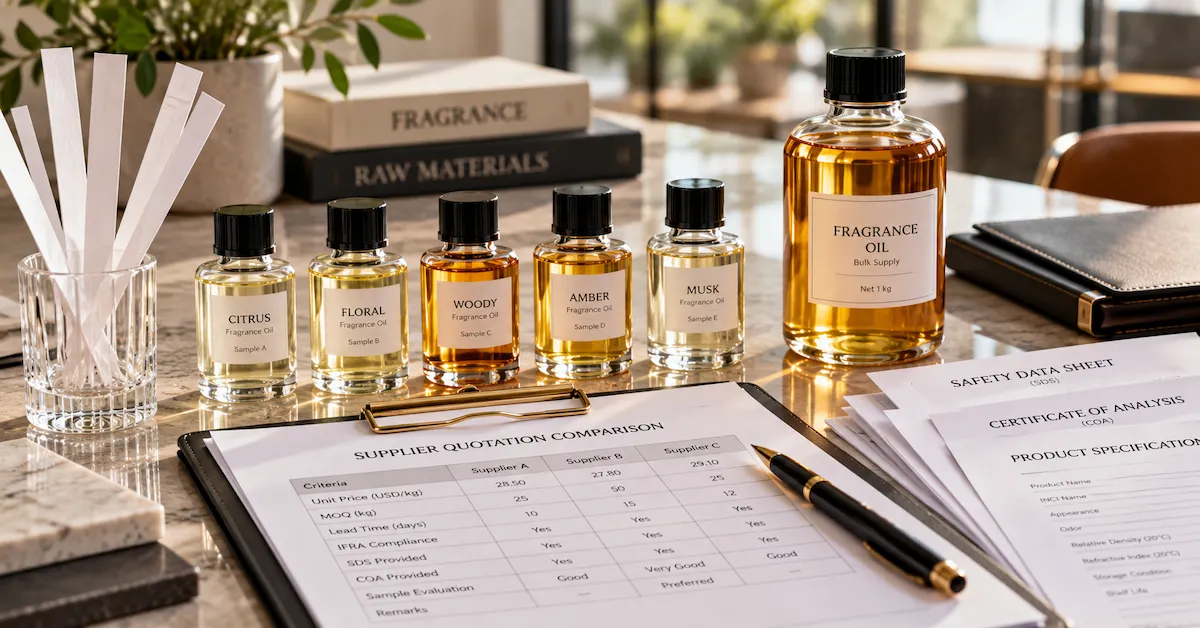
13. Frequently Asked Questions About Bulk Fragrance Oil RFQs
What should I include in a bulk fragrance oil supplier RFQ?
Include the finished-product application, formulation base, target market, fragrance direction, target cost, sample requirement, initial order quantity, annual volume, required documents and project timeline. Add packaging and delivery details when available.
Why does the formulation base matter for the quote?
The base tells the supplier what technical environment the fragrance will enter and whether application evaluation, solubility discussion or other development work may be needed. This can affect the recommended fragrance route and project scope.
How should I ask about fragrance oil MOQ?
Identify the specific fragrance or development scope, state your planned first order and estimated annual volume, and ask the supplier to confirm the applicable fragrance oil MOQ for that project and packaging arrangement.
Should I send my target price to the supplier?
If price is a real project constraint, a realistic target or range can help the supplier recommend commercially appropriate directions. State the currency, quantity basis and what the target price is expected to include.
What should I send to a fragrance oil sample supplier?
Send the application, formulation base, scent direction, target market, sample quantity, technical constraints, target cost where available, annual volume estimate and required documents.
What is a fragrance formulation service?
For an RFQ, it means the project requires more than purchasing an existing fragrance reference. The scope may involve interpreting a brief, preparing fragrance directions, adjusting samples and supporting application evaluation. Confirm exactly what the supplier includes.
Which fragrance oil regulatory documents should I request?
The required package depends on the fragrance, application and market. Common requests may include SDS, COA, IFRA-related documentation, allergen information, INCI information where applicable and product specifications. Confirm the finished-product requirements with your own regulatory team.
How do I compare two bulk fragrance oil supplier quotations?
Compare them only after confirming that both suppliers quoted the same application, fragrance or development scope, volume, packaging, document requirements and delivery basis. Record exclusions and assumptions separately.
What if my annual volume is not confirmed yet?
Provide a realistic forecast and clearly label it as an estimate. Also state the expected first order. Ask whether the supplier can provide quotation tiers for relevant volume scenarios.
Does fragrance oil sourcing China require a different RFQ?
The core RFQ inputs remain the same: application, base, market, cost, volume, documents and timeline. For international sourcing, also clarify packaging, quotation currency, delivery destination and purchasing terms. Import procedures are a separate topic from quotation accuracy.
When should I request fragrance samples?
Request samples after the supplier has enough information to understand the intended application and fragrance direction. A structured brief makes sample evaluation more useful because the sample is tied to an actual product requirement.
Should I disclose my complete formula in the first RFQ?
Not necessarily. Provide enough formulation context for the supplier to identify application risks and evaluation requirements while protecting information that does not need to be disclosed at the initial stage. If more detail is required later, define how confidential information will be handled.
Conclusion
An accurate bulk fragrance oil quote starts with seven clear RFQ inputs: application, formulation base, target market, cost, volume, documents and timeline.
Add the sample or formulation scope, compare suppliers using the same assumptions, and confirm the project-specific MOQ and documentation before bulk approval. A structured RFQ reduces guessing and gives both buyer and supplier a clearer path from brief to sample to commercial order.