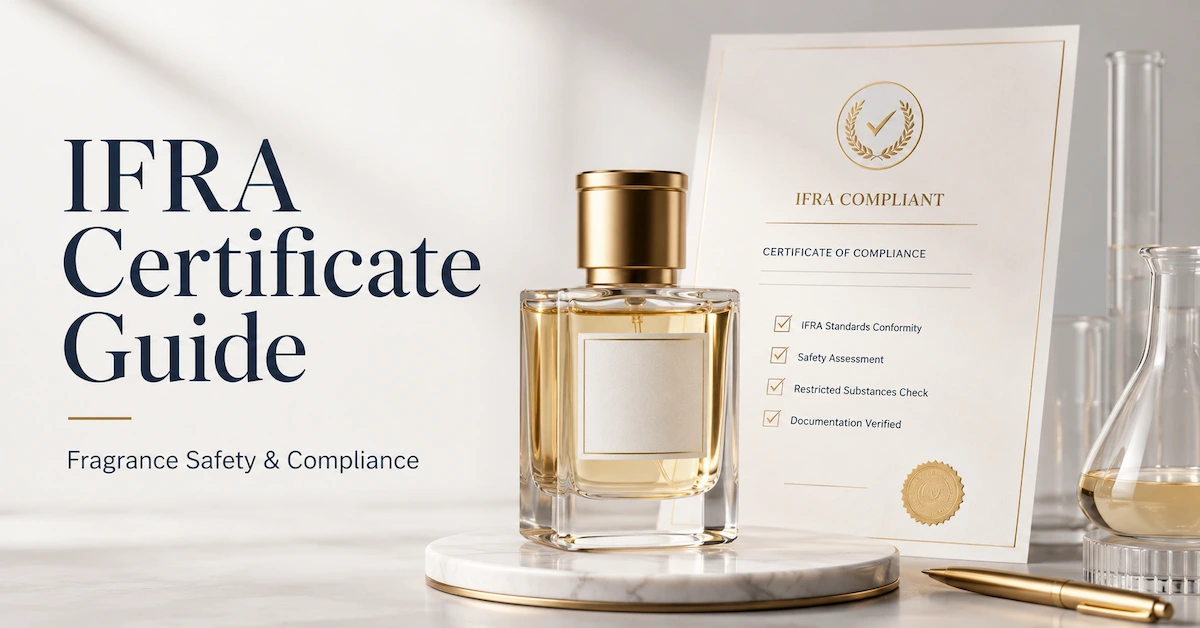
An IFRA Certificate is a fragrance safety document that confirms a fragrance formula follows the safety standards established by the International Fragrance Association (IFRA).
IFRA standards provide guidelines for the safe use of fragrance ingredients in different product categories.
For fragrance brands and manufacturers, IFRA compliance helps ensure that fragrance products are developed and used according to recognized safety requirements.
A professional fragrance manufacturer uses IFRA guidelines during fragrance development to evaluate:
- Ingredient safety
- Usage concentration
- Product application
- Regulatory requirements

What Does IFRA Stand For?
IFRA stands for the International Fragrance Association.
The organization develops global fragrance safety standards that guide the responsible use of fragrance ingredients.
The Role of IFRA Standards
IFRA standards help the fragrance industry:
- Improve consumer safety
- Establish ingredient guidelines
- Support international trade
- Provide consistent safety practices
For brands selling products globally, working with suppliers familiar with IFRA requirements can reduce compliance risks.
Why Is IFRA Certification Important for Fragrance Products?
Ensuring Fragrance Safety
Safety is one of the most important considerations in fragrance development.
IFRA compliance helps evaluate:
- Ingredient safety
- Recommended usage levels
- Product application restrictions
This is especially important for products that come into contact with:
- Skin
- Hair
- Fabrics
- Indoor environments
Supporting Global Market Compliance
Different countries and regions have different regulatory expectations.
IFRA compliance helps brands prepare fragrance products for international markets by providing recognized safety documentation.
This benefits:
- Cosmetic brands
- Home care manufacturers
- Hospitality companies
- Export businesses
Building Customer Trust
Professional documentation helps brands demonstrate:
- Product safety
- Supplier reliability
- Quality commitment
For B2B buyers, complete compliance support is often a key factor when choosing a long-term fragrance partner.
What Information Is Included in an IFRA Certificate?
An IFRA Certificate usually provides information related to fragrance safety evaluation and usage recommendations.
| Information | Purpose |
|---|---|
| Fragrance Name | Identify the fragrance product |
| Application Category | Define suitable product usage |
| Safety Assessment | Evaluate ingredient safety |
| Usage Limit | Control recommended concentration |
| Compliance Statement | Confirm IFRA guideline compliance |
Product Application Categories
Different products may have different fragrance usage requirements.
Examples include:
- Fine fragrance
- Personal care products
- Laundry products
- Home fragrance products
- Air care products
The same fragrance formula may require different evaluations depending on its final application.
IFRA Standards and Fragrance Application Categories
Fragrance safety requirements depend on how a product is used.
A professional supplier should understand different application categories.
Personal Care Products
Personal care products often have direct contact with skin or hair.
Applications include:
- Shampoo
- Body wash
- Lotion
- Cosmetics
Important considerations:
- Skin safety
- Ingredient restrictions
- Usage concentration
Home Care Products
Home care products include:
- Laundry detergent
- Fabric softener
- Cleaning products
Key requirements:
- Formula compatibility
- Safe fragrance usage
- Stable performance
Fine Fragrance Products
Fine fragrance applications include:
- Perfume
- Body spray
- Luxury fragrance products
Important factors:
- Scent performance
- Ingredient compliance
- Market regulations
Ambient Fragrance Products
Ambient fragrance applications include:
- Hotel fragrance
- Room fragrance
- Commercial scent systems
Requirements include:
- Safe indoor use
- Stable diffusion
- Consistent performance
IFRA Certificate vs SDS vs COA: What Is the Difference?
Many buyers confuse different fragrance documents.
Each document serves a different purpose.
| Document | Purpose |
|---|---|
| IFRA Certificate | Confirms fragrance safety compliance |
| SDS | Provides safety and handling information |
| COA | Provides product quality verification |
IFRA Certificate
Focuses on:
- Fragrance safety
- Usage guidelines
- Compliance standards
SDS
Focuses on:
- Chemical information
- Safety precautions
- Storage requirements
COA
Focuses on:
- Product specifications
- Testing results
- Batch information
Together, these documents help buyers evaluate both safety and quality.
How Fragrance Manufacturers Ensure IFRA Compliance

A professional fragrance manufacturer integrates compliance throughout the development process.
The process usually includes:
- Ingredient evaluation
- Formula assessment
- Safety review
- Documentation preparation
Brands can learn more about professional fragrance development through the fragrance development process.
Ingredient Evaluation
Manufacturers review:
- Raw materials
- Fragrance ingredients
- Safety information
This helps identify potential restrictions before production.
Formula Safety Assessment
Developers evaluate:
- Formula composition
- Application category
- Usage concentration
This ensures fragrance formulas meet required safety standards.
Documentation Management
Professional suppliers maintain:
- IFRA Certificate
- SDS
- COA
- Related compliance documents
Complete documentation supports smoother cooperation between manufacturers and global brands.
Risks of Working Without IFRA-Compliant Fragrance
For global fragrance buyers, working with non-compliant fragrance suppliers can create significant business risks.
Without proper safety evaluation and documentation, brands may face:
- Regulatory challenges
- Product approval delays
- Market restrictions
- Customer trust issues
Regulatory Compliance Risks
Different markets have strict requirements for fragrance safety.
If fragrance products do not meet expected safety standards, brands may experience:
- Import problems
- Product registration issues
- Compliance investigations
For international brands, selecting an IFRA-compliant fragrance supplier helps reduce regulatory uncertainty.
Product Quality Risks
Without proper compliance management, fragrance products may have:
- Unstable formulas
- Inconsistent performance
- Unexpected ingredient issues
This can affect:
- Product quality
- Customer satisfaction
- Brand reputation
Business Reputation Risks
For beauty, personal care, and hospitality brands, product safety directly influences consumer trust.
Reliable documentation demonstrates:
- Supplier professionalism
- Product responsibility
- Quality commitment
How to Choose an IFRA-Compliant Fragrance Supplier
Choosing the right supplier is an important step for brands developing fragrance products.
A qualified supplier should provide:
- IFRA documentation
- Technical support
- Quality management
- Product testing capability
Check Compliance Capability
A professional fragrance supplier should have experience managing:
- IFRA standards
- Safety documentation
- Application requirements
- Regulatory expectations
Important questions to ask include:
- Can you provide IFRA Certificates?
- Are fragrance formulas evaluated for different applications?
- Can you provide supporting documents such as SDS and COA?
Evaluate Technical Expertise
Compliance is not only about documentation. It also depends on technical fragrance development capability.
A strong supplier should understand:
- Fragrance chemistry
- Ingredient selection
- Formula compatibility
- Application requirements
For example:
A fragrance used in shampoo requires different considerations compared with fragrance used in laundry detergent or hotel scent systems.
Review Manufacturing Quality Systems

A reliable fragrance manufacturer should maintain strict quality control throughout production.
Important factors include:
- Raw material inspection
- Formula verification
- Batch testing
- Production consistency
Quality management ensures that approved fragrance formulas remain consistent during commercial production.
IFRA-Compliant Fragrance Supplier Evaluation Checklist
Before cooperation, buyers can evaluate suppliers using the following checklist:
| Evaluation Factor | Why It Matters |
|---|---|
| IFRA Compliance | Ensure fragrance safety standards |
| Documentation Support | Reduce compliance risks |
| Technical Expertise | Develop suitable fragrance solutions |
| Testing Capability | Verify product performance |
| Quality Control | Maintain batch consistency |
| Production Capacity | Support long-term supply |
A supplier with strong compliance and technical capabilities can become a long-term fragrance development partner.
Custom Fragrance Development and IFRA Compliance
For brands creating custom fragrance products, compliance should be considered from the beginning of development.
A professional development process includes:
- Understanding product application
- Selecting suitable fragrance ingredients
- Creating fragrance formulas
- Evaluating safety requirements
- Preparing compliance documentation
Brands developing customized fragrance solutions can explore custom fragrance solutions for different applications.
Compliance should not be added only at the final stage. It should be integrated into the entire fragrance development workflow.
Frequently Asked Questions About IFRA Certificate
What is an IFRA Certificate?
An IFRA Certificate is a document that confirms a fragrance formula follows IFRA safety guidelines and recommended usage requirements.
It helps brands verify that fragrance products are developed according to recognized safety standards.
Why is IFRA certification important?
IFRA certification helps:
- Improve fragrance safety
- Support global market requirements
- Reduce compliance risks
- Build customer trust
Is IFRA certification required for all fragrance products?
Requirements may vary depending on product category, market, and regulations.
However, many professional fragrance buyers require IFRA documentation when selecting suppliers.
What information does an IFRA Certificate include?
An IFRA Certificate typically includes:
- Fragrance identification
- Application category
- Safety evaluation
- Usage recommendations
- Compliance statement
What is the difference between IFRA and SDS?
IFRA focuses on fragrance safety compliance and usage recommendations.
SDS provides information about:
- Chemical properties
- Handling instructions
- Storage requirements
- Safety precautions
What products need IFRA compliance?
Common applications include:
- Perfume
- Shampoo
- Body care products
- Laundry products
- Home fragrance
- Hotel fragrance
How do fragrance suppliers get IFRA certification?
Fragrance suppliers evaluate formulas according to IFRA standards and prepare compliance documentation based on product application requirements.
Can custom fragrances have IFRA Certificates?
Yes. Custom fragrance formulas can be evaluated and documented according to applicable IFRA requirements.
What happens if fragrance is not IFRA compliant?
Potential risks include:
- Market restrictions
- Product delays
- Compliance issues
- Customer concerns
How can brands verify supplier compliance?
Brands should request:
- IFRA Certificate
- SDS
- COA
- Technical documentation
For additional compliance questions, brands can explore our fragrance technology FAQs.
Conclusion: Why IFRA Compliance Matters for Fragrance Brands
For global fragrance buyers, compliance is an essential part of supplier selection.
An IFRA Certificate is more than a document. It represents a supplier’s commitment to:
- Fragrance safety
- Product quality
- Regulatory responsibility
- Long-term cooperation
Whether developing personal care fragrances, laundry solutions, home fragrance products, or hospitality scent systems, brands should work with suppliers that combine:
- Technical expertise
- Quality control
- Compliance support
- Custom development capability
A reliable fragrance manufacturer can help brands create safe, high-quality fragrance products that meet international market expectations.
If you are looking for IFRA-compliant fragrance solutions or custom fragrance development support, contact our fragrance team to discuss your project requirements.